

5 Steps to Analyze Keyword Gaps for Videos
Want to grow your YouTube channel? Keyword gap analysis is a simple way to find untapped opportunities where your competitors are ranking, but you aren’t. By identifying these gaps, you can create videos that target proven search terms and attract more viewers.
Here’s how it works in 5 steps:
- Identify Competitor Channels: Find 3–5 channels in your niche, using tools like YouTube Studio's audience overlap feature. Look at their engagement metrics to spot high-performing content.
- Extract Competitor Keywords: Use tools like Semrush or Ahrefs to find keywords your competitors rank for but you don’t. Focus on Missing, Weak, and Untapped keywords with low competition and decent search volume.
- Rank Keywords by Potential: Prioritize keywords based on search volume, keyword difficulty, and relevance to your channel. Look for terms with high traffic potential.
- Check for Video Fit: Validate keywords by searching them on Google and YouTube. If videos dominate the results, they’re a good fit for your content.
- Create Video Ideas: Turn keywords into video concepts by matching them with viewer intent (e.g., tutorials, reviews). Use strong titles and hooks to grab attention.
Pro Tip: Regularly review your keyword gaps and update your content strategy to stay ahead of trends. Studies show this method can boost organic traffic by up to 37% in six months.
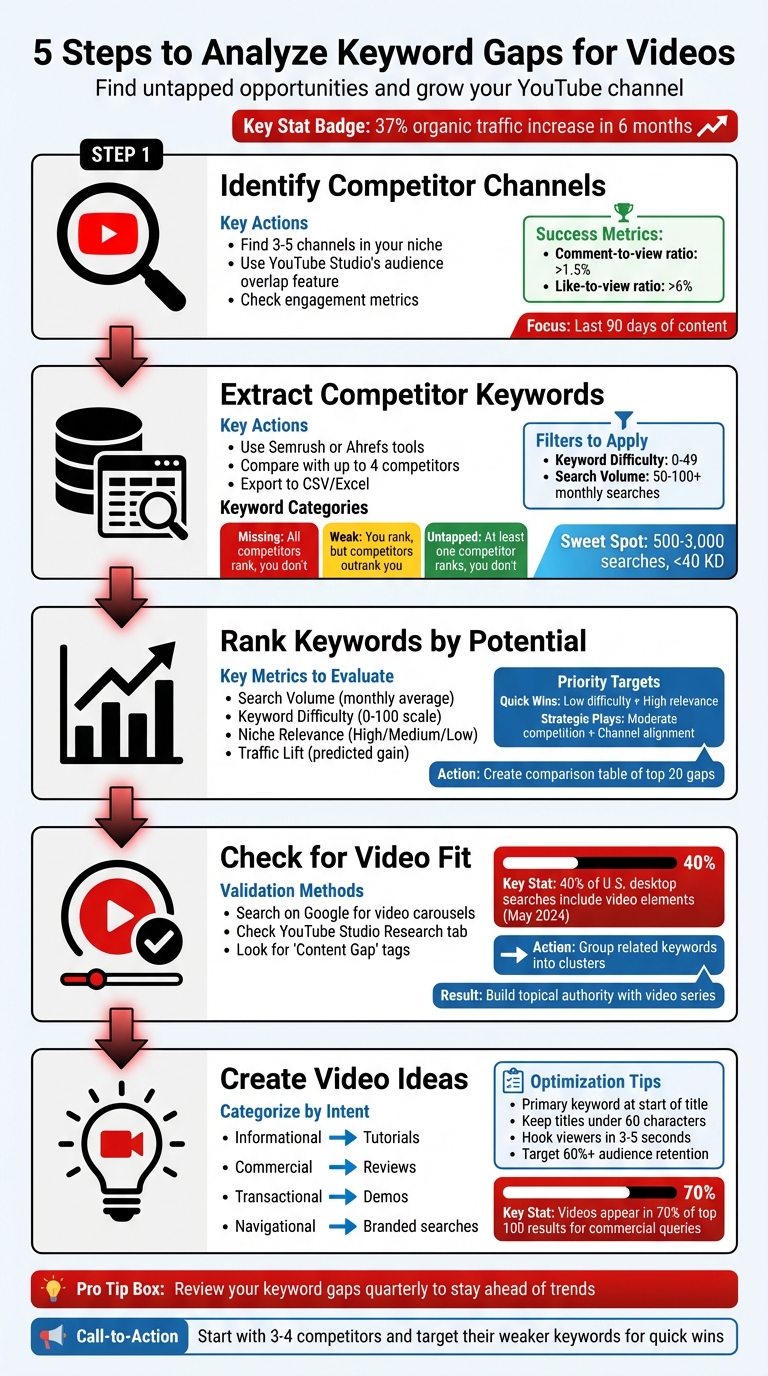
5-Step Keyword Gap Analysis Process for YouTube Videos
Semrush Keyword Gap Analysis Tutorial
Step 1: Find Your Main Competitor Channels
The first step to understanding your competition on YouTube is identifying the channels that grab your target audience's attention. These could range from direct competitors to influencers and even large publications in your niche. For example, if you're a home renovation contractor, your direct competitor might be another local contractor. But your search competitors could include major players like Home Depot or DIY influencers who dominate "how-to" search results. To pinpoint these competitors, start by systematically searching for your target keywords.
Enter your primary keywords into YouTube's search bar and take note of the top-performing channels. Additionally, YouTube Studio offers "audience overlap" data, which reveals other channels your viewers are engaging with. This feature is a goldmine for identifying who’s already capturing the attention of your audience.
Narrow your focus to 3–5 key competitors for deeper analysis. Be sure to include both direct competitors and channels that rank well for your target keywords. If you’re a smaller creator with fewer than 10,000 subscribers, prioritize competitors with a similar audience size. This approach ensures you’re setting achievable benchmarks.
Pay close attention to engagement metrics to evaluate the effectiveness of these channels. Look for a comment-to-view ratio higher than 1.5% and a like-to-view ratio above 6%. These numbers indicate active and engaged audiences. As Iryna Avramenko from ScaleLab explains:
"Copying your competitors will always put you behind. Instead, analyze their playbook, spot their blind spots, and then execute a version that fits your brand, audience, and strengths".
Once you’ve identified your competitors, dive into their content from the past 90 days. This timeframe is crucial for spotting trends and identifying standout videos that perform 3–10 times better than average. These breakout successes often highlight emerging trends, giving you the chance to create timely, relevant content before the market becomes oversaturated.
Step 2: Pull Keywords from Competitor Channels
To uncover opportunities, start by extracting keywords that are driving traffic to your competitors. This is where tools like Semrush's Keyword Gap or Ahrefs' Content Gap become indispensable. These tools allow you to compare your channel with up to four competitors, giving you a clear picture of where you stand.
Here's how it works: input your channel's URL along with those of your competitors. The tool will then sort the keywords into several categories:
- Missing: Keywords all your competitors rank for, but you don't.
- Weak: Keywords you rank for, but competitors are outranking you.
- Untapped: Keywords where at least one competitor ranks, but you have no presence.
Once you have the raw data, it’s time to refine it. Focus on top-10 ranking keywords and apply filters to zero in on opportunities that are realistic and worthwhile. Use a keyword difficulty (KD) filter of 0–49 to target less competitive terms, and set a minimum search volume threshold of 50 to 100 monthly searches.
Aaron Whittaker, VP of Demand Generation & Marketing at Thrive Internet Marketing Agency, highlights the value of being selective:
"We've found hidden potential in keywords with 500–3,000 monthly searches and less than 40 keyword difficulty, especially when paired with well-optimized content."
Pay close attention to the Missing keywords. These represent significant gaps where your competitors are capturing traffic that you're not even targeting. Similarly, the Weak keywords are low-hanging fruit - topics you already cover but need better optimization or updated metadata to improve rankings. Export your filtered lists of Missing and Untapped keywords to a CSV or Excel file, and organize them into topic clusters. These clusters can then serve as the foundation for your video content calendar.
Don't stop there. Look for keywords that trigger video carousels or thumbnails in Google search results. This ensures you're focusing on terms with proven video potential, rather than those better suited for blog posts or product pages.
Rodrigo Cesar, CEO and Founder of SSInvent, underscores this strategy:
"The real goal isn't just to see what keywords competitors rank for that you don't - it's about identifying which of those keywords are actually worth going after, based on intent, competitiveness, and your site's ability to rank."
Step 3: Rank Keywords by Video Potential
Now that you’ve identified keyword gaps in Step 2, it’s time to prioritize the ones that offer the most value. Focus on keywords from your Missing and Weak lists that have the potential to drive results. To rank them effectively, consider these key metrics: search volume, keyword difficulty, niche relevance, and traffic lift.
Search volume measures how many people search for a term each month, averaged over a year. While higher search volumes can expand your reach, relevance is key. A keyword with just 500 monthly searches that perfectly aligns with your channel can outperform a broader term with 5,000 searches that only loosely connects to your content. Always prioritize relevance over raw numbers.
Keyword difficulty (KD) is a score ranging from 0 to 100 that indicates how challenging it is to rank on the first page. If your channel is relatively new, avoid keywords with a KD above 50. Traffic lift, on the other hand, predicts how much traffic you could gain by outranking competitors for a specific keyword. This metric helps you focus on terms that can make a noticeable difference in your channel’s performance. Combine these metrics to identify keywords that not only align with your niche but also have strong traffic potential.
To keep things organized, create a comparison table for your top 20 keyword gaps. Include columns for search volume, keyword difficulty, niche relevance (rated as high, medium, or low), and traffic lift. This approach makes it easier to pinpoint Quick Wins - keywords with low difficulty, high relevance, and clear intent that can deliver fast results. Additionally, look out for Strategic Plays, which are moderately competitive keywords that align with your channel’s goals and are worth the extra effort.
If spreadsheets aren’t your thing, tools like Outlier (https://outlier.so) can simplify the process. In just two minutes, it can analyze competitor channels and provide personalized video ideas, complete with confidence scores, view velocity data, and proven content patterns. It’s a quick way to identify which keyword gaps are worth pursuing. Once you’ve ranked your keywords, you’ll be ready to determine which ones are the best fit for your video content.
sbb-itb-08cadfc
Step 4: Check Keywords for Video Content Fit
Once you've ranked your keywords, the next step is to ensure they're suitable for video content. Not all keywords are a natural fit for videos - some are better suited for blog posts or product pages. By validating the intent behind each keyword, you can avoid wasting time creating videos your audience isn't interested in.
Start by searching each keyword on Google. Look for video carousels, featured videos, or prominent YouTube results in the search engine. If videos are showing up, it's a clear sign that users expect video content. For instance, as of May 2024, around 40% of U.S. desktop search results included video elements. Additionally, you can use the Research tab in YouTube Studio to explore "Your viewers' searches" and "Searches across YouTube." Pay special attention to the "Content Gap" tag - it highlights topics where users are searching but not finding satisfying video content.
Once you've validated intent, group related keywords into clusters. This allows you to create a cohesive video series that builds authority on specific topics. For example, if there's a gap in content around "email marketing automation", you could produce a main video covering the broad topic and follow it up with supporting videos like "best email automation tools" and "how to set up email sequences." This approach not only strengthens your topical authority but also signals to YouTube's algorithm that your channel offers in-depth expertise. If a single video ranks for multiple keywords, group those terms into one cluster.
For a more efficient process, tools like Outlier (https://outlier.so) can help. It analyzes recent competitor content to highlight which formats and themes are resonating with audiences. Within minutes, you can pinpoint keyword gaps that align with proven content trends. Plus, view velocity data reveals which topics are gaining traction quickly, helping you focus on opportunities where you can stand out instead of competing in oversaturated areas.
Once you've confirmed which keywords fit video content, you're ready to turn these insights into actionable video ideas. With your keyword clusters in place, it's time to move forward and start crafting targeted video concepts in the next step.
Step 5: Create Video Ideas from Keyword Gaps
Once you've identified keyword gaps, the next move is turning those insights into actionable video ideas. This step connects your data analysis with a creative content strategy that resonates with viewers.
Start by categorizing the keywords based on intent: Informational (tutorials), Commercial (reviews), Transactional (demos), and Navigational (branded searches). This categorization shapes your approach to titles and hooks, ensuring your content matches what viewers are looking for. For instance, a tutorial might work best for informational queries, while a product comparison could suit commercial intent. Keep your primary keyword at the beginning of a title under 60 characters to avoid truncation in search results, and craft a hook that grabs attention within the first 3–5 seconds.
Your hook is critical for keeping viewers engaged. Open with something that stands out - a surprising fact, a direct question, or a clear statement of value. For example, if you're addressing "email automation setup", a title like "Automate Your Email Sequence in Under 10 Minutes" offers immediate value and aligns perfectly with the keyword gap. Remember, videos with audience retention rates above 60% are more likely to be favored by algorithms, which can boost visibility in YouTube recommendations and even Google's search results. It's worth noting that videos now appear in 70% of the top 100 results for commercial queries.
To streamline this process, tools like Outlier (https://outlier.so) can help you generate data-driven video ideas. Instead of guessing, you’ll get targeted concepts backed by evidence, allowing you to focus on creating content that meets real audience needs.
Once your titles and hooks are optimized, you can move into production with confidence, knowing you're addressing genuine demand in your niche.
Conclusion
By following this five-step process - starting with identifying competitors and ending with creating targeted video ideas - you can tap into traffic opportunities you might have otherwise missed. Keyword gap analysis turns guesswork into a precise, data-driven approach for growing your YouTube presence. Extracting competitor keywords, ranking them by video potential, assessing content fit, and crafting focused video ideas lets you zero in on topics that are already proven to attract viewers.
The results speak for themselves: studies indicate that consistent keyword gap analysis can increase organic traffic by as much as 37% within six months.
As Outlier explains, "A keyword gap analysis isn't just a list of keywords. It's a strategic deep dive into your competitors' strengths, market opportunities, and the blueprint for a content plan".
To get started, focus on 3–4 key competitors and target their weaker keywords for quick wins. Outlier’s personalized video ideas, backed by data, help you create content that truly connects with your audience.
Make it a habit to review your analysis every quarter to stay aligned with shifting trends. The aim isn’t to close every gap - it’s about being strategic, choosing battles wisely, and focusing on opportunities that match your channel’s strengths and your audience’s interests.
FAQs
How can I find competitor channels to analyze for keyword gaps?
To identify competitor YouTube channels for a keyword gap analysis, zero in on creators who cater to the same audience and operate within your niche. Specifically, look for channels that:
- Discuss similar topics or themes.
- Use a style or content approach comparable to yours.
- Draw viewers whose interests align with your audience.
Begin by searching for the keywords you currently rank for or plan to target on YouTube. Pay close attention to the channels and videos that dominate the search results, particularly those featured in the "Related" or "Recommended" sections. Channels that consistently show up across multiple keyword searches are likely strong contenders for deeper analysis.
Once you've compiled a shortlist, tools like Outlier can help streamline the process. These tools analyze competitor channels, reveal the keywords they rank for, and identify gaps in your own strategy. By blending manual research with these data insights, you can zero in on the most relevant competitors and sharpen your content game.
What’s the best way to find and analyze competitor keywords for my YouTube videos?
To get a solid grasp on competitor keywords, a combination of free and paid tools can work wonders. YouTube Studio and Google Trends are excellent starting points. They allow you to pinpoint search terms that drive traffic to similar channels and identify trending topics worth exploring.
For more detailed insights, tools like VidIQ and TubeBuddy step in with features such as search volume metrics, competition analysis, and keyword suggestions. These tools make it easier to discover terms with less competition but high audience interest - perfect for standing out in a crowded space.
If you’re after a YouTube-specific tool, Outlier is worth considering. It uses competitor data and trends to generate tailored video ideas, complete with suggested titles and hooks. The best part? It does this in just minutes, streamlining your content planning process. By combining these resources, you can uncover valuable keyword opportunities and create videos that truly connect with your audience.
How can I choose the right keywords for my YouTube videos?
When choosing keywords for your videos, aim for terms that directly reflect your video's content and connect with your audience's interests. Prioritize keywords with strong search volume, reasonable competition levels, and untapped potential where competitors might have overlooked opportunities. Use tools to analyze relevance, demand, and ranking difficulty, and consider running a keyword-gap analysis to pinpoint areas where your content can stand out.


