

How To Brainstorm Video Ideas as a Team
Generating video ideas as a team can help you create better, more focused content. Instead of relying on one person, team brainstorming brings diverse perspectives together, leading to ideas that align with your goals. Here's how to do it effectively:
- Prepare Ahead: Define clear goals, create a detailed video brief, and assign roles like facilitator and note-taker.
- Set Ground Rules: Encourage open sharing without judgment, document all ideas, and stick to time limits.
- Use Brainstorming Techniques: Try methods like brainwriting, starbursting, or timed sticky notes to spark creativity.
- Leverage Data: Tools like Outlier analyze successful content to guide your ideas.
- Refine and Prioritize: Group ideas by themes, evaluate them against criteria like audience interest and feasibility, and vote to select the strongest ones.
Team brainstorming works best with structure, preparation, and data-driven insights. By following these steps, you can turn scattered ideas into actionable video strategies.
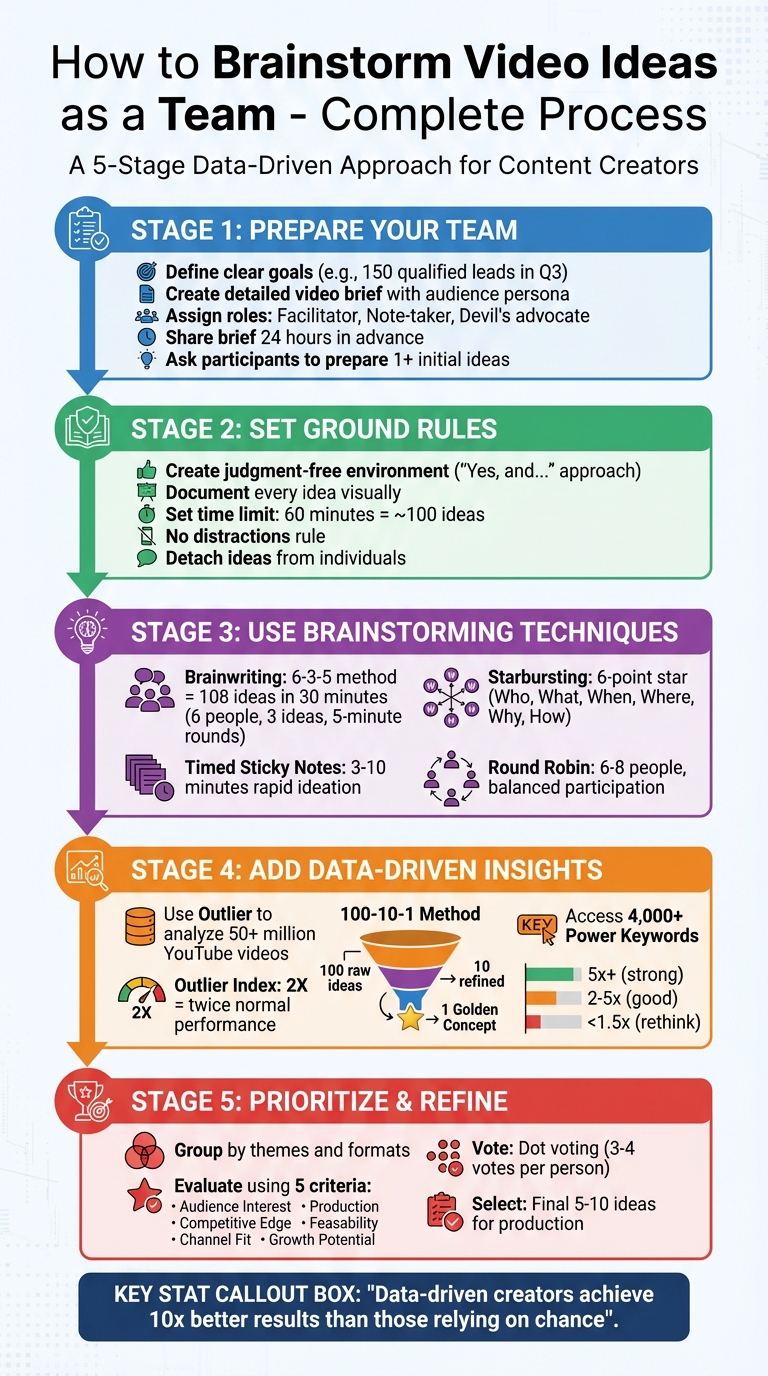
5-Step Team Video Brainstorming Process: From Preparation to Final Selection
5 BRAINSTORMING Methods to THINK OUT OF THE BOX | How to innovate in small groups and teams
sbb-itb-08cadfc
Prepare Your Team Before the Brainstorming Session
Brainstorming works best with solid preparation. Without it, teams can get stuck on basics instead of diving into meaningful ideas. The effort you put into planning will determine whether you walk away with actionable strategies or just a list of vague suggestions.
Define Goals and Create a Video Brief
A well-crafted video brief is your team's roadmap. It ensures everyone stays focused on clear, measurable goals. Instead of general objectives, aim for specifics - like generating 150 qualified leads in Q3 or achieving 500 new sign-ups within 60 days. Your brief should also include a detailed audience persona. Go beyond surface-level demographics and create a story, such as "Maria, a manager struggling with scattered communications who’s seeking a streamlined solution".
Ian Sells of JoinBrands emphasizes that a strong brief outlines not just what to create but why it matters.
Set creative boundaries upfront. Outline your brand's colors, fonts, legal requirements, and visual style. Don’t forget to specify the intended platform - whether it's TikTok, LinkedIn, or another channel - as this will shape details like aspect ratio, pacing, and calls-to-action. Share the brief with your team at least 24 hours before the session, so they come prepared and ready to contribute. With this groundwork in place, your team can focus on generating ideas rather than clarifying basics.
Assign Roles and Responsibilities
Clear roles make brainstorming sessions more productive. Start by designating a facilitator. This person will guide the meeting, keep discussions on track, manage time, and encourage quieter team members to share their thoughts. Assign a scribe to document every idea - whether on a whiteboard or digital tool - so the rest of the group can focus on brainstorming. Including people from various departments, like customer support, sales, and marketing, adds valuable perspectives.
"Their purpose will be to keep things moving, record ideas, and know when it's time to move on. They're there to nudge the team when they need it so everyone else can stay focused on keeping ideas flowing."
142 Productions
You can also assign roles like a devil's advocate to challenge ideas and a decision-maker to help finalize them. These roles ensure the session stays organized and productive.
Ask Participants to Prepare Initial Ideas
Avoid starting the session with a blank slate. Ask each participant to come with at least one video idea. This approach sparks creativity and reduces the risk of groupthink - where early suggestions can unintentionally limit the scope of the discussion.
Sharing the brief 24 hours in advance allows participants time to process and brainstorm. Research supports this approach: a 1958 Yale study found that individuals working alone often generate twice as many creative solutions as groups do.
"Early ideas tend to have disproportionate influence over the rest of the conversation. They establish the kinds of norms, or cement the idea of what are appropriate examples or potential solutions for the problem."
Loran Nordgren, Professor, Kellogg
Set Ground Rules for the Brainstorming Session
Ground rules turn chaotic discussions into productive creative sessions. Without clear guidelines, conversations can drift off-track. By setting specific rules, teams stay focused and unlock their creative potential.
Create a Judgment-Free Environment
Encouraging openness is essential for sparking creativity.
Criticism can shut down creativity faster than anything else. If team members fear judgment, they’re less likely to share bold or unconventional ideas. To combat this, save all critiques for after the brainstorming phase. This shift from evaluation to open idea generation creates space for fresh, unexpected concepts. Encourage wild suggestions - sometimes the most unconventional ideas lead to the best solutions. A great way to foster this mindset is by using the "Yes, and…" approach instead of "but" when building on ideas.
"Ideation is about shared invention. Attaching a single person to a single idea hinders collaboration and greatness."
Brendan Boyle, Instructor, IDEO U
Additionally, detach ideas from individuals to avoid ego conflicts. Treat every idea as a team contribution, and set aside professional titles during the session to promote equality and collaboration.
Document Every Idea
A dedicated note-taker is essential to capture every idea. Use a visible medium - like a whiteboard or sticky notes - so everyone can see and build on the ideas being shared. Visual aids also help uncover patterns and connections among suggestions. Before erasing anything, make sure to take photos for future reference.
"The imagination wants to run free, not be hemmed in by judgements and objections... No idea is too stupid or outlandish to be written on the board."
William Gadea, Creative Director and Founder, IdeaRocket
For remote teams, digital tools are effective, but in-person sessions often benefit from the tactile experience of writing on sticky notes or using markers. The goal is to create a record that can be revisited and refined later.
Set a Time Limit
Time limits help keep the session energetic and on track. A focused 60-minute brainstorming session can yield around 100 ideas. Break the time into segments, like 10 minutes for silent brainstorming, 40 minutes for sharing, and 10 minutes for reviewing ideas. This structure helps maintain momentum and focus.
"Fluency is a very rapid flow of ideas, so there's never more than a moment of silence. Flexibility is approaching the same idea from different viewpoints."
Tom Kelley, Author, The Art of Innovation
To ensure full participation, enforce a "no distractions" rule. By keeping everyone fully engaged, the flow of ideas becomes more natural and collaborative.
These ground rules lay the foundation for productive and creative brainstorming sessions.
Use Proven Brainstorming Techniques
Effective brainstorming strategies can transform scattered ideas into focused, actionable concepts. Different teams respond to different methods, so it’s worth trying a few to see what works best for your group. Below are some approaches designed to tap into your team’s creative potential.
Brainwriting for Silent Ideation
Brainwriting is perfect for giving everyone a chance to contribute - especially those who might not speak up in traditional discussions. Each participant writes 1–3 ideas on separate slips of paper or digital cards. These are then passed to the next person, who adds their thoughts or enhancements. This continues until all ideas have circulated, and the group discusses which ones to pursue.
"Brainwriting is the introvert's version of brainstorming."
Conceptboard
This technique avoids "blocking", where dominant voices overshadow others or participants forget their ideas while waiting to speak. A popular variation, the 6-3-5 method (6 people, 3 ideas each, 5-minute rounds), can yield 108 ideas in just 30 minutes. To keep things manageable, aim for groups of 10 people or fewer.
Starbursting for Detailed Concept Development
Starbursting is ideal for fleshing out a single idea into a fully developed concept. Start by placing the core idea at the center of a six-point star, with each point representing one of these questions: Who, What, When, Where, Why, and How. This ensures your team addresses critical details like audience, challenges, and execution.
For instance, if your idea is a "behind-the-scenes product launch video", starbursting could help you explore: Who the video is for (current customers or new prospects), What moments to highlight (team reactions, first orders), Why viewers would care (humanizing your brand), and How to structure it (chronological or thematic). This method is especially useful during the planning phase to ensure no aspect is overlooked.
Timed Sticky Notes for Quick Idea Generation
This fast-paced method focuses on generating a high volume of ideas. Set a timer - typically for 3–10 minutes - and have participants write as many ideas as they can on separate sticky notes. For a 60-minute session, aim for 100 ideas to increase the odds of uncovering a standout concept.
"It is easier to tone down a wild idea than to think up a new one."
Alex Osborn, Author and Creator of the Brainstorming Technique
After the timer ends, group similar ideas and review them together. This rapid "braindumping" clears mental clutter and encourages creativity by preventing overthinking or self-editing.
Round Robin for Balanced Participation
Round Robin ensures that everyone in the group has a chance to contribute. Team members take turns sharing one idea each in a set order, with no interruptions or feedback allowed until everyone has spoken. In some versions, the next person builds on the previous idea before adding their own.
This method is particularly effective for larger groups or when dealing with dominant personalities. For best results, keep the group size to 6–8 people, as larger groups can slow the process and require stricter facilitation.
Add Data-Driven Insights with Outlier
Boost your team's creative efforts by combining them with precise, data-driven analysis. Data helps confirm which ideas from your brainstorming sessions are likely to succeed. Outlier examines over 50 million YouTube videos to pinpoint content that performs far above a channel's average. This gives your team a clear view of what resonates with audiences similar to yours.
At the heart of Outlier is the Outlier Index, which measures a video's performance during its first seven days (V7 Views) compared to the channel's six-month average. For instance, a 2X index means a video is performing twice as well as usual. The platform even allows you to filter for standout videos on smaller channels, helping you spot viral ideas. This kind of clarity transforms raw data into actionable insights, guiding your creative decisions.
"Outliers shows you what videos already resonates with audiences and by how much helping you research more effectively and make better decisions."
Spotter Studio
Once you've identified a standout video, the "Brainstorm from an Outlier" tool steps in to help. It generates data-backed suggestions for titles, thumbnails, and hooks. For example, one creator used Outlier to refine their content strategy, leading to a flagship series that not only boosted views and revenue but also saved time during the planning process.
A proven approach to using these insights is the 100-10-1 Method: start with 100 raw ideas, narrow them down to 10 using Outlier's data, and finally select one "Golden Concept" to bring to life. Outlier also provides access to over 4,000 "Power Keywords" - terms shown to drive higher engagement in YouTube titles. With these tools, your team can craft language that grabs attention while ensuring your ideas are both creative and strategically aligned. Together, this blend of human ingenuity and data validation makes your brainstorming sessions far more effective.
Prioritize and Refine Your Video Ideas
Once you've brainstormed collaboratively and analyzed your data, the next step is to refine and prioritize your video concepts.
Group Ideas by Themes and Formats
Start by organizing your ideas into categories based on format, theme, or visual style. This method not only makes your list more manageable but also helps you identify patterns and gaps in your content strategy. Often, grouping similar ideas can highlight a stronger central concept that might not have been obvious before.
Evaluate Ideas Using Clear Criteria
To narrow down your options, assess each idea against specific benchmarks. Consider the following factors:
- Audience Interest: Does the idea resonate with your audience? Use metrics like outlier scores and search volume to validate this.
- Competitive Edge: Does your concept offer a unique angle or better quality compared to existing content?
- Production Feasibility: Can you realistically produce this within your budget and timeline?
- Channel Fit: Does the idea align with your channel's niche and overall strategy?
- Growth Potential: Is there room to expand the concept into a series or use it for collaborations or monetization?
A scoring system can help you objectively evaluate these factors. For example, videos with outlier scores above 5x indicate strong potential, while scores between 2-5x suggest good potential. Scores below 1.5x may require rethinking. Before committing, ask yourself: "Would I click on this myself?" and "Does this address a specific need for my audience?".
Here’s a quick breakdown of the evaluation criteria:
Evaluation Criterion
Key Assessment Questions
Audience Interest
Are there recent outlier videos on this topic? Is search volume high?
Competitive Edge
Does this idea stand out? Can you outperform existing content?
Feasibility
Do you have the resources and time to produce it?
Channel Fit
Does it align with your channel's niche and goals?
Growth Potential
Can this idea evolve into a series or open monetization opportunities?
Vote and Select Top Ideas
Once you've evaluated your options, it's time to vote on the best ideas. Dot voting is a simple and effective method where each team member gets 3-4 votes to allocate using stickers or digital markers. For remote teams, tools like Google Forms allow for anonymous voting and easy data summaries, reducing the risk of groupthink.
To add depth to the process, you can use color-coded dots to represent different attributes - one color for "highest engagement potential" and another for "easiest to produce". While everyone should have a say, it's crucial to appoint one or two decision makers who understand the overall business goals. These individuals will make the final call on which 5-10 ideas move forward into production. This approach strikes a balance between team input and strategic oversight.
Conclusion
Team brainstorming flourishes when it's guided by structured techniques and supported by data. Begin by setting clear goals and assigning roles to your team. Then, apply methods like brainwriting, starbursting, or round robin to encourage a wide range of ideas without criticism. Once you've gathered these raw ideas, shift toward making strategic decisions - relying on data rather than gut feelings to determine what works best. This approach creates the foundation for refining ideas using measurable criteria.
"I study what works before I create anything new"
MrBeast
Top creators, like MrBeast, focus on analyzing data before diving into new projects. Tools such as Outlier help streamline this process by identifying standout concepts - content that performs 3-5 times better than a channel's average. By combining structured brainstorming with prioritization, you can group ideas by themes, evaluate them against clear standards, and vote to narrow down hundreds of concepts into the strongest contenders. Creators who adopt a data-driven approach often achieve 10x better results compared to those who rely solely on chance.
FAQs
How can we make sure everyone contributes during a team brainstorming session?
To make sure everyone gets a chance to contribute during a brainstorming session, consider using structured techniques like the round-robin approach. This method ensures that each team member has a turn to share their ideas, preventing louder voices from dominating the discussion and encouraging quieter participants to join in.
Before the session, set clear expectations by sharing an agenda and highlighting the importance of hearing different perspectives. During the meeting, establish a safe, judgment-free space by setting ground rules - like avoiding criticism and focusing on building upon others' ideas. These steps can create an environment where everyone feels comfortable sharing their thoughts.
What should we consider when choosing and prioritizing video ideas?
To pick and prioritize video ideas that truly hit the mark, start by looking at data-driven insights. Dive into performance metrics, current trends, and viewer engagement stats. For instance, pinpoint topics that have consistently performed well or show signs of increasing interest - this can give you a solid sense of what might succeed.
Beyond the numbers, think about your audience's questions, challenges, or goals. Creating content that connects with their needs and adds value is key to boosting engagement and growing your channel. Focus on ideas that strike a balance between being relevant to your viewers and backed by strong data. This way, your videos will not only grab attention but also deliver meaningful results.
How can data-driven insights improve team brainstorming for video ideas?
Using data-driven insights can supercharge your team's brainstorming sessions by pinpointing which types of content resonate most with your audience. By diving into trends and analyzing high-performing videos, you can spot patterns, themes, and formats that have already proven successful. This approach eliminates much of the guesswork, allowing your team to channel their creativity into ideas that are more likely to grab attention and engage viewers.
Take tools like Outlier, for example. They analyze competitor content and audience behavior to provide tailored video ideas, complete with suggested titles, hooks, and supporting data. This turns brainstorming into a more strategic process, where every idea is backed by performance metrics. The result? Your team saves time while crafting content that’s primed to make an impact.


