

Competitor Analysis for Niche Research
Competitor analysis is the backbone of finding success on YouTube. If you're struggling to grow your channel, here’s the solution: study your competitors to spot content gaps, identify high-performing strategies, and uncover underserved niches. This approach ensures your content aligns with audience demand and stands out in crowded spaces.
Key Takeaways:
- Why it matters: A clear niche improves algorithm recommendations and boosts audience retention. Broad topics like "Gaming" are too saturated - narrow your focus for better results.
- Steps to follow:
Find competitor channels: Use YouTube search, related channels, and audience overlaps to identify rivals. - Analyze top content: Spot "outlier videos" (3x-10x better than average) and break down their structure, topics, and thumbnails.
- Identify content gaps: Dive into comments and social media to find unmet audience needs.
- Leverage tools like Outlier: Automate insights, track trends, and get data-backed video ideas.
- Choose a niche: Use metrics like demand-to-supply ratio and outlier frequency to validate your niche.
Pro Tip: Test your niche by creating 3–5 videos and tracking performance metrics like click-through rate (>4%) and view duration (>50%).
This systematic approach ensures you're not guessing but making data-driven decisions to grow your channel.
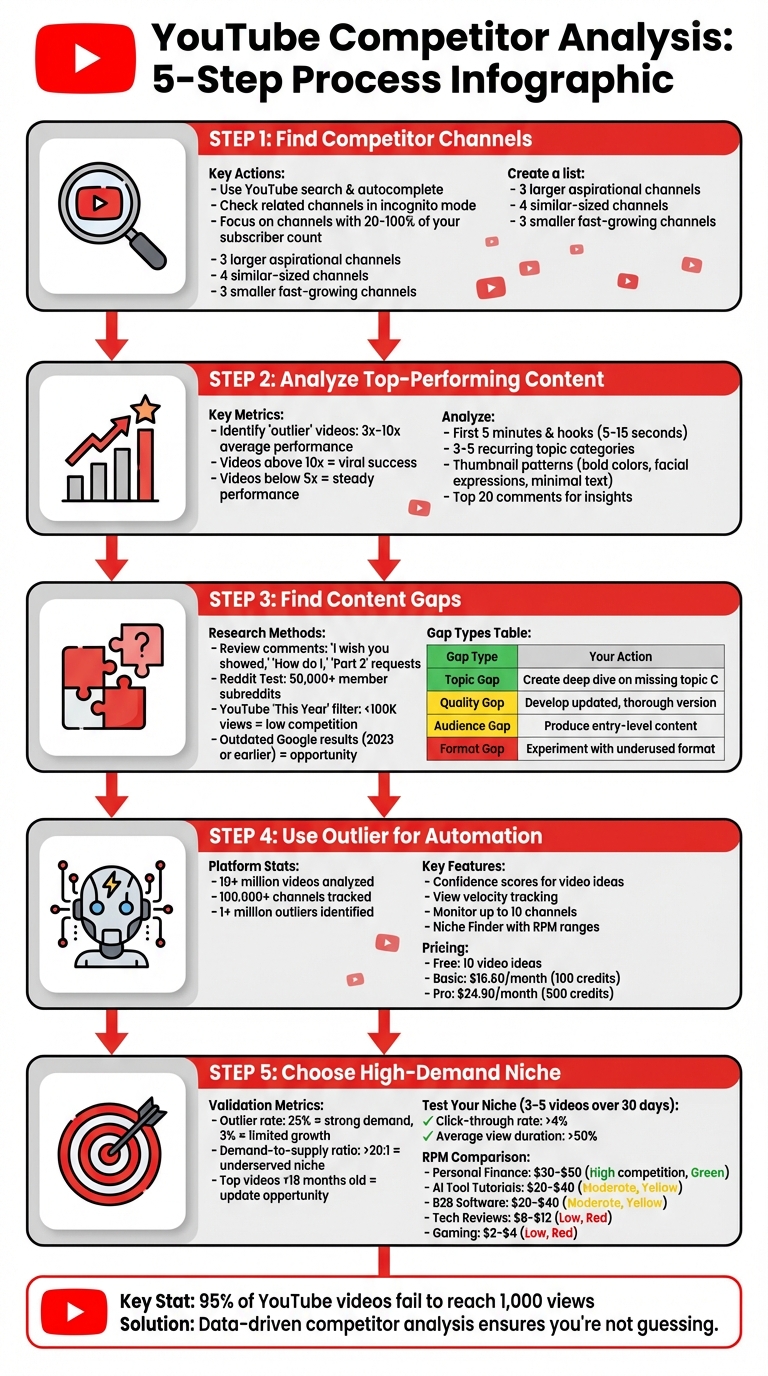
5-Step YouTube Competitor Analysis Process for Niche Research
How to Research Your YouTube Niche for Maximum Profit and Success (Niche Down to Blow Up Part 3)
sbb-itb-08cadfc
Step 1: Find Competitor Channels
Step one is all about identifying the key players in your niche.
Use YouTube Search and Related Channels
Start with the YouTube search bar. Type in your main topic, and take note of the autocomplete suggestions. These suggestions reflect exactly what viewers are searching for and highlight which channels dominate those search terms. It’s a straightforward way to uncover the channels ranking for your target keywords.
Then, switch to incognito mode and watch some of the top-performing videos in your niche. Once a video ends, YouTube will recommend related content. Pay attention to channels that consistently pop up in these recommendations - they’re likely your direct competitors. Incognito mode ensures that your personal viewing history doesn’t influence the results.
For benchmarking, focus on channels with 20% to 100% of your subscriber count. You can also expand your analysis to include channels within a 10× subscriber range. This approach ensures you’re comparing yourself to a balanced set of competitors.
To get a clearer picture of the competition, create a list of 5–10 channels and organize them by size:
- 3 larger, aspirational channels
- 4 channels similar in size to yours
- 3 smaller, fast-growing creators
This mix will help you understand what’s working at different levels - what’s effective for large-scale channels, what’s relevant for your current size, and what fresh ideas are emerging from newer creators.
Once you’ve built your list, dig deeper by reviewing audience feedback and social conversations.
Check Audience Overlaps and Social Media
Dive into the comments section of videos in your niche. Look for mentions of other channels or recurring questions that aren’t being addressed. These insights can help you identify competitors while also revealing content gaps you could fill.
Explore niche communities on platforms like Reddit and social media. Search for your niche keywords on Reddit, especially in subreddits with 50,000 to 500,000 members. If people are frequently asking for channel recommendations, it could indicate an audience that’s not fully served. Pay attention to the YouTube channels that get mentioned repeatedly in these discussions - they’re worth adding to your competitor list.
Lastly, check the upload activity of any channel you’re analyzing. If a channel hasn’t posted in the last three months, it might be inactive. While this could mean less competition, it may also signal a lack of demand in that niche. Focus on channels that are consistently uploading and engaging with their audience.
Step 2: Analyze Top-Performing Content
Once you've identified competitor channels, the next step is to dig into their content and figure out what truly connects with their audience.
Identify High-Performing Videos
Start by spotting "outlier" videos - those that achieve 3x to 10x the channel's average performance. You can calculate this by dividing a video's peak views by the channel's average views. Videos with ratios below 5x indicate steady performance, while those above 10x often signal viral success. To get a reliable picture, focus on the most recent 10–20 uploads from each channel and exclude any one-off viral hits.
Pay attention to the view-to-subscriber ratio. This metric can reveal how well a topic is engaging the audience. For instance, a video with 200,000 views on a channel with 2 million subscribers has only a 10% ratio, which might indicate the topic isn't resonating as strongly as expected.
Early momentum is another key indicator. Monitor how many views a video gets in the first 48–72 hours. To stay updated on trending topics in your niche, use YouTube's search filters and set "Upload date → This year". These insights will help you identify niches with proven demand.
Look for Patterns in Topics, Formats, and Thumbnails
Once you've identified high-performing content, it's time to break down the elements that drive its success.
Most successful channels stick to 3–5 recurring topic categories - like tutorials, reviews, or experiments - that make up the majority of their uploads. These "topic buckets" often account for 80% or more of their content.
When it comes to video titles, look for recurring structures or formulas. Popular formats include questions, numbered lists, or comparisons like "X vs Y". Instead of copying specific ideas, focus on the underlying templates. For example, titles like "How to [Outcome] (Without [Pain])" or "I Tested [X] for [Time Period]" are versatile and effective.
Thumbnails are another critical factor. Take screenshots of 10–15 top thumbnails, arrange them in a grid, and analyze patterns. Look for common features like bold colors, close-up facial expressions, minimal text, or "before and after" designs.
Also, study the first 5 minutes of top-performing videos. Pay attention to their hook strategies - do they use open loops, bold claims, or problem-first intros within the first 5–15 seconds?. Finally, dive into the comments section. The top 20 comments often highlight what viewers appreciated most, while negative feedback can reveal gaps you could address in your own content.
"The difference between channels that grow and channels that stall is rarely talent - it's strategy." - Aditi, Founder of OutlierKit
Step 3: Find Content Gaps and Opportunities
Now that you've analyzed what makes your competitors successful, it's time to uncover the areas they’re missing. This step is about identifying the gaps in their content and spotting opportunities to meet audience demand where competition is low. These gaps often represent untapped potential, giving you a chance to create content that stands out and resonates with viewers.
Review Comments and Audience Feedback
Competitor video comment sections are a goldmine of insights. By examining the top 10 videos from 5–10 competitors, particularly their standout or "outlier" videos, you can gather a wealth of audience feedback. These high-performing videos not only attract a lot of views but also generate diverse comments that reveal what viewers are looking for.
Pay close attention to comments that express frustration or unmet needs. Phrases like "I wish you showed", "How do I", or "The biggest mistake" often point to missing information. Requests for follow-ups, such as "Part 2", signal areas where you can step in with fresh content. Another clue? When creators fail to respond to comments, it indicates an overlooked audience. By engaging directly with these viewers, you can build stronger loyalty and stand out in the niche.
"Content gaps found in competitor comment sections represent proven audience demand with low supply - the highest-probability opportunity on YouTube." – TubeAI Learn
Once you've gathered insights from comments, validate your findings by diving into trending keywords and exploring underused content formats.
Research Trending Keywords and Unused Formats
Take the insights from comments a step further by studying trends and formats. YouTube's "This Year" filter is a great tool for assessing the current competitive landscape. Search your primary keyword and filter by upload date - if there are only a few videos exceeding 100,000 views, it’s a sign of low competition and high potential.
Another method is the Reddit Test. Search your niche keywords in subreddits with 50,000+ members. If you notice frequent requests for recommendations, such as "a good YouTube channel", it’s a clear sign of an underserved audience. Similarly, outdated top Google results (from 2023 or earlier) for your keyword suggest a gap that a new, high-quality video could fill.
You can also identify gaps in video styles within your niche. If most creators focus on one format (like tutorials) but neglect alternatives like case studies or side-by-side comparisons, this is your chance to offer something different. Before diving into a full-scale production, try testing the waters with a "5-Shorts Test": publish five YouTube Shorts using different hooks related to the topic. If each Short gets over 1,000 views within 30 days, you’ve found an idea worth pursuing.
Gap Type
Implication
Your Action
Topic Gap
Competitors cover topics A and B, but not C
Create a deep dive on topic C first
Quality Gap
Existing content is outdated
Develop a more updated, thorough version
Audience Gap
Content focuses on experts, ignoring beginners
Produce entry-level content to fill the void
Format Gap
An underused format exists in the niche
Experiment with this underserved format
Step 4: Use Outlier for Automated Insights
Outlier takes the manual legwork out of competitor analysis, offering automated insights that speed up the process of discovering winning video ideas.
How Outlier Simplifies Competitor Analysis
Manual competitor research can be time-consuming, but Outlier streamlines the process by identifying "outlier videos" - those that perform 5 to 10 times better than a channel's average view count. The platform has analyzed over 10 million videos and 100,000 channels, identifying more than 1 million high-performing videos. All you need to do is input competitor YouTube URLs, and within minutes, Outlier delivers personalized video ideas, complete with suggested titles, hooks, and confidence scores. No subscription or account connection is required to get started.
"Smart creators don't guess, they steal what's already working." – Outlier.so
Key Features of Outlier
Outlier doesn't just tell you which videos are performing well - it breaks down why they work. From hooks and pacing to retention strategies and curiosity loops, the platform provides a detailed analysis.
One standout feature is the Confidence Score, which ranks AI-generated video ideas based on their potential for success. Outlier also tracks view velocity, helping you spot trending topics before they become saturated. Another useful tool is the Niche Finder, which organizes niches by RPM ranges, competition levels, and growth trends, with updates every 30 days.
You can monitor up to 10 channels to track their strategies, format experiments, and upload schedules in real time. Outlier even dives into comment sections, uncovering content gaps and audience questions that competitors may have missed.
These features make it easier to identify and capitalize on high-demand niches.
Find High-Demand Niches with Outlier
Outlier's insights and analytics help you pinpoint profitable niches by highlighting topics with outlier performance and exposing content gaps. Look for niches where smaller channels are already achieving massive views - this often signals untapped potential for new creators.
The niche comparison tool allows you to evaluate multiple categories side-by-side, considering factors like growth rate, monetization potential, and competition levels. For example, in March 2026, Personal Finance & Investing niches had CPM ranges of $18 to $45, while Gaming niches ranged from $3 to $8 - a stark revenue difference despite similar view counts.
Sarah Kim, a tech educator, leveraged Outlier's trending niche alerts to identify a growing interest in AI tutorials two months before the topic peaked in early 2026. Her videos on the subject ended up driving 80% of her monthly traffic.
Similarly, Marcus Johnson used the Niche Finder to launch a faceless automation channel in a low-competition, high-RPM niche. Within just three months, he gained 10,000 subscribers.
Outlier's free plan offers 10 personalized video ideas to help you test the platform. Paid plans begin at $16.60/month (billed annually) and include 100 credits, AI-curated niche reports, and trending niche alerts. For those who want deeper insights, the Pro plan at $24.90/month (billed annually) provides 500 credits and advanced research tools that generate video ideas validated for the next 30–60 days.
Step 5: Choose a High-Demand Niche
Focus on Niches with Proven Demand
After analyzing competitor channels, top-performing content, and identifying content gaps, it’s time to zero in on a niche with strong potential. Leverage your competitor research and apply the 3-Circle Framework: find a niche that aligns with your expertise, has clear market demand, and faces minimal competition. Let data guide you in this process.
One way to validate demand is by identifying outlier videos in your chosen niches. As mentioned in Step 2, these are videos that perform 3x to 10x better than a channel’s average views. A high frequency of outliers indicates a strong, replicable demand for that content. For example, a niche with a 25% outlier rate suggests a repeatable formula for success, while a 3% rate might signal limited growth opportunities.
Another helpful metric is the demand-to-supply ratio. This is calculated by dividing the monthly search volume of a keyword by the number of videos with that keyword in their title. A ratio higher than 20:1 points to an underserved niche with good growth potential. Additionally, if top-ranking videos for a keyword are over 18 months old, it’s a sign that the niche could benefit from updated content. Finally, if many of the top results come from smaller channels (under 10,000 subscribers), it’s a clear opportunity for newer creators to break in.
By combining these data points with insights into content gaps, you can confidently validate the demand for your chosen niche.
Evaluate and Compare Niche Options
Once you’ve narrowed it down, compare your top three to five niche options using metrics like competition level, outlier frequency, content gap scores, and estimated RPM (Revenue Per Mille). This comparison helps you identify which niche offers the best mix of growth potential and revenue.
Niche Category
Est. RPM
Competition Level
Outlier Score
Personal Finance
$30–$50
High
7.8
AI Tool Tutorials
$20–$40
Moderate
9.0
Minimalist Tech Reviews
$8–$12
Low
7.4
Mobile Game Fails
$2–$4
Low
9.2
B2B Software Reviews
$20–$40
Moderate
8.1
For instance, high-RPM niches like Personal Finance can generate up to 20 times more revenue per view compared to low-RPM niches like Gaming. However, higher RPM often means stiffer competition, so it’s crucial to weigh the trade-offs.
Before fully committing to a niche, test it by publishing three to five videos targeting specific keywords. Monitor key metrics like a click-through rate above 4% and an average view duration exceeding 50% during a 30-day period. These benchmarks will help confirm whether the niche resonates with your audience and is worth further investment.
Conclusion and Next Steps
Reviewing the Competitor Analysis Process
Competitor analysis is all about uncovering the strategies behind successful videos and tailoring those insights to fit your own style and goals. This guide has walked you through every step - finding competitor channels, analyzing their best-performing content, identifying content gaps, and using data to validate high-demand niches.
By studying elements like hooks, thumbnails, topics, and formats, you can figure out what truly connects with audiences. Even digging into comment sections can highlight gaps - questions or needs that viewers have but aren't being addressed. This process is a huge reason why some creators grow faster than others.
Remember, your niche should align with your expertise, meet audience demand, and have a level of competition you can handle. Narrowing your focus - such as shifting from "Gaming" to "Budget Roguelike Games" - can help you avoid overcrowded spaces. This is crucial when 95% of YouTube videos fail to reach even 1,000 views.
Use these insights to fine-tune your content strategy right away.
Take the First Step: Start Analyzing Competitors
Now that you have a solid framework, it’s time to take action. Analyze channels that are 10 to 100 times larger than yours to gather practical insights. Pay close attention to their standout videos, especially the first 30 seconds, and create a list of content gaps you can fill.
Tools like Outlier make competitor analysis faster and easier. It provides personalized video ideas in just two minutes by evaluating competitor content from the last 90 days. You’ll get actionable insights like suggested titles, hooks, confidence scores, and view velocity data - all without needing a subscription or linking your YouTube account. You can even test it out with 10 free video ideas at Outlier.
To validate your niche, create 3–5 videos over the next 30 days. Aim for a click-through rate above 4% and an average view duration over 50%. This approach ensures you won’t waste time on topics that are oversaturated or lack demand. Stay competitive by reviewing trends weekly and diving deeper into your niche monthly. Start your analysis today and take the first step toward growing your channel.
FAQs
How do I pick the right competitor channels to study?
To pick the best competitor channels to analyze, look for ones that match your size and target audience. Pay close attention to their outlier videos - those that perform way better than their usual content. These can reveal strategies you might adapt for your own channel. Dive into their engagement metrics and comments to spot content gaps or overlooked topics that could resonate with viewers. Tools like TubeBuddy or VidIQ can be invaluable for tracking trends and making sure your analysis stays focused and data-backed.
What should I copy vs avoid copying from outlier videos?
When analyzing outlier videos - those that perform 3 to 10 times better than average - focus on identifying themes, formats, and topics that clearly connect with viewers. Steer clear of directly copying specific hooks, presentation styles, or branding elements. These are often unique to the creator and may not align with your channel’s voice. Instead, use these successful strategies as inspiration while staying true to your own style and identity.
How do I know my niche test is working after 30 days?
After 30 days, take a close look at your niche test results by diving into key metrics like engagement rates, subscriber growth, and content gaps. Stack your performance against competitor benchmarks to see how you measure up and determine if your content aligns with what the market is asking for. Pay attention to signs of momentum - things like higher interaction rates or improved audience retention. These can be strong indicators that your test is heading in the right direction.


