

Cross-Platform Content: Common Mistakes to Avoid
Reposting the same content across all platforms is a mistake. Why? Each platform has its own style, audience, and rules. What works on YouTube might flop on TikTok or Instagram. Research shows platform-specific content drives 40-70% higher engagement, while creators who tailor their strategy see 73% better results.
Here’s what to avoid:
- Using identical content everywhere.
- Ignoring platform-specific formats (e.g., TikTok’s vertical videos vs. YouTube’s horizontal ones).
- Neglecting performance data to refine your approach.
- Spreading yourself too thin across too many platforms.
- Losing brand consistency by shifting tone or visuals too much.
The fix? Focus on 2-3 platforms, repurpose content smartly, and track key metrics for each platform. Tools like Outlier can help you spot trends and refine your strategy faster. Tailor your content, measure results, and stick to your brand voice for better engagement and reach.
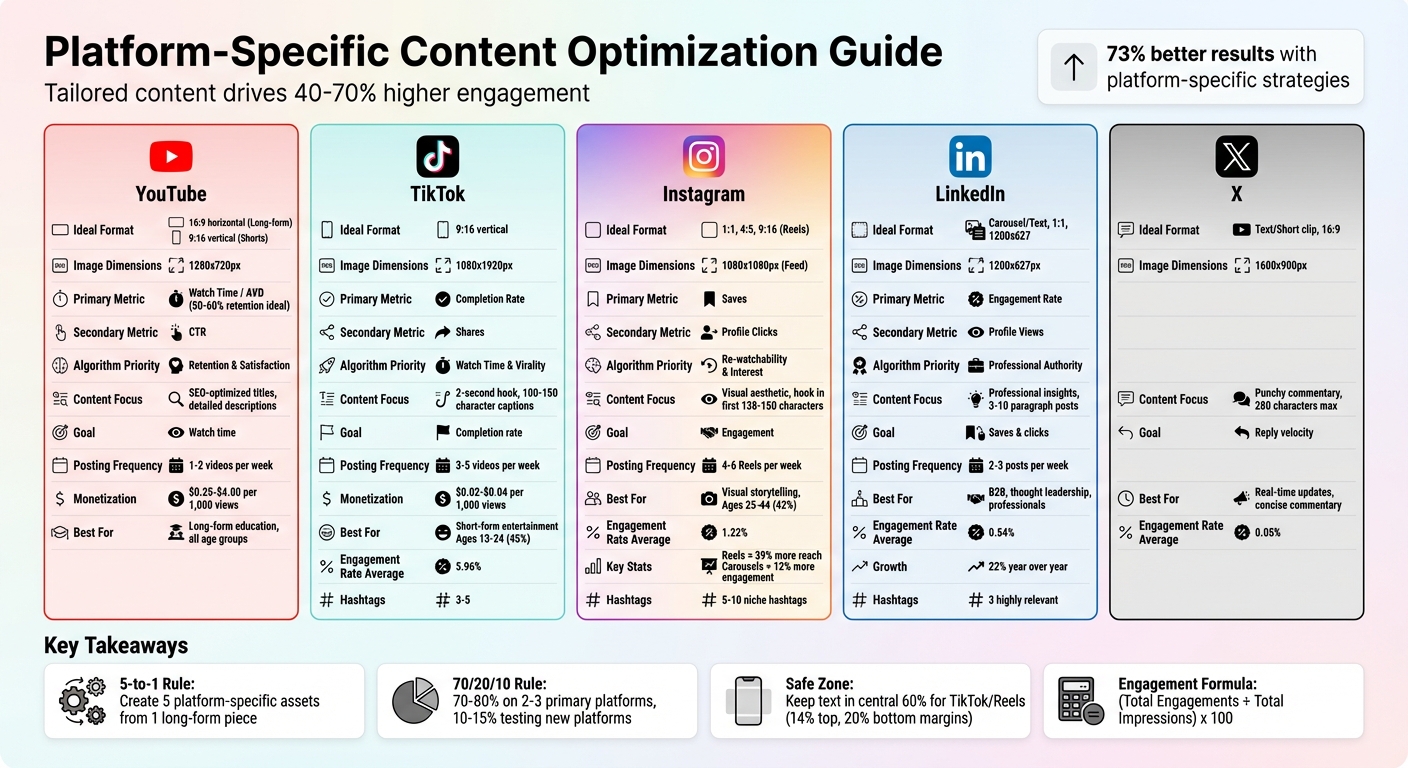
Platform-Specific Content Optimization Guide: Formats, Metrics, and Best Practices
How to Cross-Promote Content on Every Social Platform (TikTok, IG, YT, LinkedIn, FB in 2025)
Mistake 1: Posting the Same Content on Every Platform
It’s easy to fall into the trap of clicking “share everywhere” after creating a piece of content. After all, the hard part - creating the content - is already done, so why not spread it across platforms? The problem is that copy-pasting the same content across platforms rarely performs well. When you post identical videos, captions, or images on Instagram, TikTok, LinkedIn, and X (formerly Twitter) without any adjustments, you’re missing how each platform is designed to be used.
Why One-Size-Fits-All Content Fails
Every platform serves a different purpose and attracts a unique audience. Instagram users are drawn to visually appealing content and inspiring stories. LinkedIn users are there for professional insights and industry updates. TikTok thrives on quick, entertaining snippets, while X caters to real-time updates and sharp, concise commentary. A horizontal, 10-minute YouTube tutorial won’t resonate with TikTok’s fast-paced, vertical format or its audience’s expectations.
Platform algorithms prioritize content that fits their specific formats and styles. Posts that ignore these nuances often get buried, receiving less visibility and engagement. Worse, content that doesn’t meet basic technical requirements - like aspect ratios or image resolution - comes across as sloppy and unprofessional, making users scroll right past it.
Another issue is viewer fatigue. Loyal followers who follow you on multiple platforms might see the same post repeatedly. Instead of feeling engaged, they’re likely to feel bored - or worse, annoyed.
"If you copy-paste the same caption everywhere, you're ignoring how each platform's audience actually consumes content".
This highlights the importance of tailoring content to match the unique strengths and audience expectations of each platform.
How to Make Content Platform-Specific
The solution isn’t creating entirely new content for every platform - it’s about smart repurposing. Start with one strong piece of content, like a 30-minute YouTube tutorial, and break it down into platform-appropriate formats. For example:
- TikTok and Instagram Reels: Extract a 15-second “quick tip” in a vertical 9:16 format.
- LinkedIn: Turn the key takeaways into a professional carousel or a detailed text post.
- X (Twitter): Share a standout statistic or an eye-catching fact in a punchy text post.
- YouTube: Stick with a horizontal 16:9 format and optimize your title and description for search.
- Instagram Feed: While Reels offer 39% more reach, carousels drive 12% more engagement through likes, comments, and shares.
Each platform calls for a different approach. For TikTok and Reels, start with a captivating 2-second hook to grab attention. On LinkedIn, open with a compelling line that encourages saves and clicks. Meanwhile, Instagram’s visual aesthetic prioritizes high-quality imagery, and X thrives on concise, impactful commentary.
Platform
Ideal Format
Focus
Goal
YouTube
16:9 horizontal
SEO-optimized title
Watch time
TikTok/Reels
9:16 vertical
2-second hook
Completion rate
LinkedIn
Carousel/Text
Professional insight
Saves & clicks
Instagram Feed
4:5 or 1:1
Visual aesthetic
Engagement
X (Twitter)
Text/Short clip
Punchy commentary
Reply velocity
To streamline this process, try the 5-to-1 rule: for every long-form piece of content, create at least five smaller, platform-specific assets. This doesn’t mean duplicating the same post - it means crafting five variations that feel natural and engaging for their respective platforms.
"Make your content work for the platform, don't make the platform work for your content".
Mistake 2: Ignoring Platform-Specific Visuals and Copy
Even when creators understand the importance of adapting their content, many overlook the specific visual and copy requirements unique to each platform. For instance, a TikTok video with the wrong aspect ratio can get penalized, while a LinkedIn post written in casual TikTok slang may feel out of place. These mismatches not only reduce engagement but also hurt your brand’s credibility.
This challenge goes beyond just technical specs. Each platform has its own vibe and communication style, and users are more likely to trust content that feels native to the platform. If your visuals are cropped, stretched, or pixelated because of improper formatting, your content immediately comes across as unprofessional. Similarly, using the wrong tone in your captions or posts signals that you don’t fully understand the platform’s audience.
"In social media, visual content isn't just king - it's the whole kingdom." - Sprout Social
The stakes are high. Brands that nail cross-platform content distribution see engagement rates soar by 73%. On the flip side, content that doesn’t meet platform-specific requirements often gets buried by algorithms. YouTube prioritizes watch time, Instagram values saves and shares, and TikTok rewards videos with high completion rates. If your visuals and copy aren’t aligned with these priorities, you’re setting yourself up for failure. Let’s dive into how to fine-tune visuals and tailor copy for each platform’s unique style.
Optimizing Visuals for Each Platform
Getting the format right is just the start. Visual details need to align with what audiences expect on each platform. Using the wrong aspect ratio can result in quality downgrades by algorithms. For example:
- TikTok and Instagram Reels: Vertical 9:16 videos
- Instagram feed posts: Square (1080x1080px) or portrait (1080x1350px)
- YouTube long-form content: Horizontal 16:9
- YouTube Shorts: Vertical 9:16
- LinkedIn posts: Professional graphics at 1200x627px
It’s also crucial to consider the "safe zone." On TikTok and Instagram Reels, text and logos should stay within the central 60% of the screen. This avoids interference from interface elements like icons or buttons. Specifically, leave about 14% (roughly 250 pixels) at the top and 20% (around 340 pixels) at the bottom free of text to keep everything legible.
Beyond dimensions, the type of content also matters. For instance, Instagram Reels deliver 39% more reach than carousels and 122% more than single-image posts. However, carousels generate 12% more engagement than Reels and 114% more than single images. Choosing the right format depends on whether you’re aiming for reach or engagement.
Platform
Visual Format
Image Dimensions
Key Consideration
YouTube
16:9 (Long), 9:16 (Shorts)
1280x720px
SEO-optimized thumbnails
Instagram
1:1, 4:5, 9:16
1080x1080px (Feed)
High-quality aesthetic
TikTok
9:16
1080x1920px
Hook in first frame
LinkedIn
1:1, 1200x627
1200x627px
Professional graphics
X (Twitter)
16:9
1600x900px
Concise visuals
Writing Copy That Fits the Platform
Visuals might grab attention, but it’s the copy that keeps users engaged. Crafting platform-specific copy is just as important. For example:
- YouTube: Treat it like a search engine. Use SEO-optimized titles, detailed descriptions (up to 5,000 characters), and timestamps with relevant keywords.
- Instagram: Focus on visual storytelling. Include a strong hook in the first 138–150 characters to ensure it appears before the "see more" cutoff.
- TikTok: Keep captions concise - 100–150 characters that complement the video without distracting from it.
"Captions can make or break your social media content." - Conor Eliot, Head of Creator Partnership, OpusClip
Tone also plays a big role. LinkedIn works best with a professional yet conversational tone, often in longer posts (3–10 paragraphs) that share in-depth insights. TikTok thrives on casual, trend-savvy language that feels authentic, while X (formerly Twitter) demands short, impactful commentary within 280 characters.
Hashtags and calls-to-action (CTAs) should also align with each platform’s norms. For example:
- YouTube and TikTok: Use 3–5 hashtags.
- Instagram: Opt for 5–10 niche hashtags.
- LinkedIn: Stick to 3 highly relevant hashtags.
CTAs should match platform behavior - think "Link in bio" for Instagram, "Link in comments" for LinkedIn, and "Subscribe" for YouTube.
Timing is everything. On TikTok, grab attention within the first 2 seconds. Similarly, on Instagram and LinkedIn, deliver your key message before the "see more" cutoff. This strategy isn’t about clickbait; it’s about making sure your audience immediately understands the value you’re offering. By tailoring both visuals and copy, you can create content that feels native and resonates with each platform’s audience.
Mistake 3: Not Tracking Performance Data
If you’re not tracking performance data, you’re essentially flying blind. Without understanding what clicks with your audience - or why some content falls flat - you risk wasting time and resources while making the same mistakes over and over. Just as tailoring content for each platform is non-negotiable, so is measuring its impact.
Without metrics, you can’t fine-tune your strategy. You might be putting effort into a platform where your content barely makes a dent while overlooking one where it could thrive. 78% of creators now manage content across three or more platforms, which makes it critical to know what’s working and where. Without this clarity, there’s no way to replicate successes or fix what’s not working.
"Watch time is the clearest indicator of how engaging and valuable a video is... the main driver behind YouTube's algorithm." - Thomas J Law, Oberlo
Here’s a staggering fact: 95% of YouTube videos get fewer than 1,000 views. Many creators never figure out why. The key difference between those who succeed and those who don’t often comes down to using data to guide decisions instead of relying on guesswork. Let’s explore how to set up the right metrics and how tools like Outlier can turn numbers into actionable strategies.
Setting Up Metrics for Each Platform
Each platform has its own priorities, so tracking the same metrics across all of them won’t cut it. For example, YouTube focuses heavily on Watch Time (total minutes watched) and Average View Duration (AVD). A strong AVD typically reaches 50% to 60% of the total video length. Another key metric is the Click-Through Rate (CTR), which often predicts whether a video will go viral. Given that over 70% of daily YouTube views come from its recommendation system, these metrics directly influence whether your content gets promoted.
On Instagram Reels, metrics like Saves, Profile Clicks, and Shares are the most important. These actions signal that your content is valuable enough for users to revisit or share. Similarly, TikTok prioritizes Completion Rate (the percentage of viewers who watch your video to the end) and Shares. Interestingly, a TikTok video with 50 shares but 5,000 likes will outperform one with 5,000 likes but only 10 shares.
LinkedIn, on the other hand, requires a different approach. Metrics like Engagement Rate and Profile View Rate help measure your professional reach and authority. With the platform experiencing a 22% growth rate in 2025-2026 and Gen Z increasingly turning to it for career-related video content, understanding these metrics is more important than ever.
Here’s an easy breakdown of key metrics by platform:
Platform
Primary Metric
Secondary Metric
Algorithm Priority
YouTube
Watch Time / AVD
CTR
Retention & Satisfaction
Instagram
Saves
Profile Clicks
Re-watchability & Interest
TikTok
Completion Rate
Shares
Watch Time & Virality
LinkedIn
Engagement Rate
Profile Views
Professional Authority
To calculate your Engagement Rate, use this formula:
(Total Engagements ÷ Total Impressions) x 100. Then, compare your results to industry averages: TikTok averages 5.96%, Instagram 1.22%, LinkedIn 0.54%, Facebook 0.18%, and Twitter (X) 0.05%. If your numbers fall short, dig into the data to pinpoint what’s holding you back.
With these metrics in place, the next step is figuring out how to turn raw data into actionable strategies. That’s where Outlier comes in.
Using Outlier for Data-Driven Insights
Tracking metrics is just the first step. The real challenge lies in interpreting that data and using it to refine your content strategy. Enter Outlier, a tool designed to simplify this process. Instead of manually combing through analytics dashboards across platforms, Outlier analyzes competitor content and trends to provide tailored YouTube video ideas in just two minutes.
Here’s how it works: Outlier identifies "outlier" videos - content that performs significantly better (e.g., 10x more views) than a channel’s average. By spotting these anomalies, the tool uncovers what resonates with audiences and highlights content gaps you haven’t addressed. It even suggests titles, hooks, and supporting data like view velocity, along with confidence scores to help prioritize ideas. And the best part? You don’t need a subscription or even a YouTube account to use it.
"The difference between those [failed] videos and the ones that succeed? Strategy backed by data, not luck." - Aditi, OutlierKit
This approach shifts your mindset from reactive to proactive. Instead of guessing your next move, you’re creating content based on what your audience wants but hasn’t seen from you yet. For example, if Outlier detects a surge in competitor videos about platform-specific strategies, you can jump in and create your own version before the trend becomes oversaturated. The tool’s confidence scores help you prioritize high-potential ideas, so you’re not wasting time on topics that won’t perform.
Outlier’s biggest advantage is its speed and simplicity. Traditional analytics tools require hours of cross-referencing data, spotting patterns, and drawing conclusions. Outlier condenses this into a two-minute report, giving you actionable strategies you can apply right away. By continuously refining your approach with these insights, you can stay ahead of the curve and improve your content’s performance across platforms.
sbb-itb-08cadfc
Mistake 4: Spreading Content Across Too Many Platforms
Focusing your energy on a few key platforms is just as important as tailoring your content and tracking metrics. Trying to manage content across every platform might feel like a good strategy, but it often leads to a drop in quality. Many creators mistakenly believe that being on more platforms equals more success. The reality? Spreading yourself too thin often results in mediocre content everywhere.
Here’s a staggering fact: 78% of creators now handle content across three or more platforms. But most of them are doing it wrong. Posting manually to five or more channels leaves creators overworked, leading to burnout and diluted content quality. This scattershot approach makes it impossible to fully optimize for any one platform. For example, you might miss out on maximizing YouTube’s watch time or TikTok’s shareability because you’re too busy juggling everything.
"Spreading yourself thin across five platforms produces mediocre content on all of them. Quality on fewer platforms beats mediocre presence everywhere." – InfluenceFlow
The Better Strategy: Focus on a Few Platforms
Instead of trying to be everywhere, focus on 2–3 platforms where your audience actually spends time and where your content format thrives. When done right, brands that optimize their content for multiple platforms can see engagement rates that are 2–3 times higher than those sticking to just one platform. The secret lies in strategic selection and gradual expansion, rather than attempting to conquer every platform at once.
Choosing the Right Platforms
Selecting the right platforms starts with understanding where your audience is most active, aligning monetization with your financial goals, and playing to your content strengths. Getting this wrong could mean hours wasted on content that either doesn’t reach the right people or doesn’t generate income.
Here’s a quick guide:
- For B2B or professional content: LinkedIn and YouTube are your best bets. LinkedIn is growing by 22% year over year and is increasingly popular with Gen Z for career-related content.
- For beauty and fashion: TikTok and Instagram are essential.
- For educational or expertise-driven content: YouTube’s long-form videos paired with LinkedIn’s credibility-building tools deliver strong results.
Monetization also plays a big role. For instance, YouTube pays between $0.25 and $4.00 per 1,000 views, while TikTok offers just $0.02 to $0.04 for the same number of views. If sustainable income is your goal, YouTube should be high on your priority list.
Here’s a breakdown of platforms and their strengths:
Platform
Primary Audience
Content Strength
Posting Frequency
TikTok
Ages 13–24 (45%), 25–44 (32%)
Short-form entertainment/trends
3–5 videos per week
Instagram
Ages 25–44 (42%)
Visual storytelling/Reels
4–6 Reels per week
YouTube
All age groups
Long-form education/depth
1–2 videos per week
LinkedIn
Professionals/B2B
Thought leadership/expertise
2–3 posts per week
Threads
Ages 18–34 (68%)
Real-time conversation
1–3 posts daily
To manage your time effectively, use the 70/20/10 rule: dedicate 70–80% of your resources to 2–3 primary platforms, 10–15% to testing emerging platforms like Threads or BeReal, and the rest to community management. This approach keeps you focused while still allowing room for experimentation. Let performance data guide you on when to branch out further.
Expanding Gradually
Once you’ve mastered your primary platforms, you can think about expanding - but do it strategically. One of the biggest mistakes creators make is jumping into new platforms too soon. Focus on building a strong foundation first to ensure consistency and quality.
When expanding, stick to platforms that use similar content formats. For instance, if you’re already creating short-form vertical videos for TikTok, transitioning to Instagram Reels or YouTube Shorts is a natural next step. Similarly, if you’re creating long-form content for LinkedIn, repurposing it into blog posts or YouTube scripts takes minimal extra effort.
"Posting poorly on six platforms is worse than posting well on three. Build your workflow, then scale." – Jamie Partridge, Founder & CEO, PostEverywhere
To prevent burnout, batch your content creation. For example, film or write multiple pieces in one session to maintain a steady posting schedule without exhausting yourself daily. This method can save you up to 20 hours a week compared to creating unique content for each platform. Start with one “core asset,” like a YouTube video or a blog post, and break it into at least five smaller pieces for social media. This approach, known as the content ladder strategy, maximizes your reach without requiring extra recording or writing time.
Finally, pay attention to “exit signals.” If a platform isn’t generating engagement or opportunities after three months, it’s time to reallocate your efforts to channels that perform better. Remember, the goal isn’t to be everywhere - it’s to excel where it matters most.
Mistake 5: Losing Brand Consistency Across Platforms
Adapting content for different platforms is important, but it’s easy to cross the line and lose your brand’s identity in the process. When your brand voice shifts too much between platforms, it creates confusion for your audience. 75% of consumers expect a consistent experience from a brand, no matter which channel they use. Keeping your brand persona steady helps people recognize you and builds trust across all touchpoints.
This issue is more common than you might think. Imagine building a strong following on Instagram, only for your audience to feel disconnected when they encounter your brand on LinkedIn. If your tone changes drastically - like a professional brand suddenly going full-on quirky with TikTok dance trends - it can make your messaging feel scattered and unreliable. Inconsistencies like this can leave potential customers doubting your credibility.
"Your potential customers are getting whiplash trying to figure out who you actually are. This identity crisis is costing you money." – Vie Media
Creating Core Brand Guidelines
A brand style guide is your safety net for staying consistent across platforms. It helps you adapt to different formats without losing your core identity. Think of it this way: your brand voice is like a person at a party. While the tone might shift depending on the conversation, the personality and message stay the same.
Your style guide should include detailed instructions for visual elements like logo variations (with size and spacing rules), color palettes (with HEX and RGB codes), typography, and imagery style. It should also define your brand’s voice as if it were a person - how it talks, what it cares about, and how it interacts with others. Including "before and after" examples can help anyone creating content for your brand stay on track.
Consistency is key for elements like logo usage, colors, fonts, tone of voice, and imagery. While your tone can adjust to fit the platform - formal for LinkedIn, casual for TikTok - your core voice should always come through. For instance, you might explain a topic professionally on LinkedIn but take a conversational approach on Instagram. The delivery changes, but the expertise and personality remain the same.
Keep your style guide and assets centralized (tools like Google Drive or Notion work well) so your team always has access to the latest version. Schedule quarterly or biannual brand audits to catch any discrepancies - like mismatched logos or off-brand messaging - before they confuse your audience. This is especially important since 62% of consumers struggle to choose between similar small businesses, making brand recognition a major advantage.
Examples of Consistent Cross-Platform Branding
Brands that stick to clear guidelines stand out, no matter where you encounter them.
Duolingo is a great example. Its playful yet slightly sassy owl mascot and signature green color are instantly recognizable across its app, social media, and push notifications. Whether you’re being reminded to practice Spanish or watching a TikTok, you know it’s Duolingo.
Amazon takes a more professional route with its focus on "customer obsession." Its iconic smile logo and informative tone stay consistent across platforms, from retail to AWS, reinforcing its customer-first approach.
Glossier leans into a minimalist aesthetic that ties together its packaging, store design, and social media presence. Whether you’re scrolling through Instagram, visiting a store, or opening a product, the experience feels unmistakably Glossier.
When creating content, think modular. Your core value propositions should stay intact, but the format should fit the platform. For example, a YouTube video script can be transformed into a LinkedIn article, an Instagram carousel, or a Twitter thread. Each version should align with the platform’s norms while staying true to your brand’s identity. Regular brand audits will help you maintain this balance and ensure your cross-platform presence evolves without losing its essence.
Conclusion
Cross-platform content isn't just about posting everywhere; it's about being relevant on each platform. The creators who thrive in 2026 will be the ones who recognize that every platform has its own style, audience expectations, and algorithmic quirks. Sure, posting the exact same content across platforms might seem like a time-saver, but it comes at a cost - lower engagement, reduced reach, and missed revenue opportunities.
The most common pitfalls - like using generic content, overlooking platform-specific formats, ignoring analytics, spreading resources too thin, or losing brand consistency - often come down to one issue: treating cross-platform strategy as an afterthought instead of an integral part of the content plan. The upside? These missteps are entirely avoidable. Here’s how: create content that fits each platform’s unique style, use real data to measure success instead of guessing, focus on the platforms where your audience is most active, and maintain a consistent brand voice across formats. When you align your content with the strengths of each platform, the results speak for themselves.
"The winners in 2026 are those with platform-specific creator strategy systems that maximize each channel's potential." – InfluenceFlow Guide
A smart starting point is to create one high-quality piece of content - your "pillar" asset - and repurpose it thoughtfully for each platform. The message stays consistent, but the presentation is tailored to fit the platform’s vibe. This modular approach strikes a balance: you get the efficiency of repurposing while enjoying the engagement boost that comes from tailored content. In fact, tailored posts can drive 40-70% higher engagement compared to generic ones.
Finally, let data guide your strategy. Tools like Outlier deliver quick, actionable insights in just 2 minutes, turning content creation into a more predictable and effective process. By tailoring, tracking, and refining your approach, you can create a system that works smarter - not harder.
FAQs
What are the best practices for repurposing YouTube content across different platforms?
To make the most of your YouTube content across different platforms, start with your main video and adjust it to suit the style and preferences of each platform. Simply copying and pasting won’t cut it - each platform has its own vibe, audience, and format that you’ll need to cater to.
For instance, you can take a lengthy YouTube video and turn it into bite-sized, attention-grabbing clips for TikTok or Instagram Reels. Meanwhile, key quotes or still images from the video can be transformed into impactful posts for LinkedIn or Facebook. By tailoring your content to each platform, you’ll boost engagement and expand your reach.
To make this process smoother, consider using tools that help with editing and scheduling. This not only saves time but also ensures your messaging stays consistent. With this strategy, you can tap into a variety of audiences while getting the most value out of your original content.
What key metrics should I track to measure content performance on different platforms?
To evaluate how your content performs across various platforms, focus on metrics that match your objectives and leverage each platform's unique features.
For YouTube, keep an eye on metrics like views, average watch time, audience retention, and engagement (such as likes, comments, and shares). If monetization is part of your strategy, metrics like CPM (cost per thousand impressions) can offer insights into your earning potential.
On platforms like TikTok or Instagram, metrics such as video views, watch duration, and completion rates are key indicators of how engaging your content is. Meanwhile, on LinkedIn, performance can be measured through profile views, post interactions, and new connections, which highlight how well your content resonates with a professional audience.
By tracking these platform-specific metrics, you can refine your approach to deliver content that strikes a chord with your audience and drives better results.
How can I keep my brand consistent across different social media platforms?
To keep your brand consistent across social media, start by developing a brand style guide. This guide should outline your visual identity, tone of voice, and key messaging. Having these elements clearly defined ensures that your content reflects your brand’s personality, no matter which platform you’re using.
While maintaining consistency, tweak your tone to fit the unique vibe of each platform. At the same time, keep visual elements like logos, colors, and fonts uniform. This makes your brand instantly recognizable while still aligning with the style of each social network. Using a content calendar can also help you plan and schedule posts, ensuring your messaging stays aligned over time.
Don’t forget to regularly review your performance metrics. By analyzing what resonates with your audience, you can refine your approach and strengthen your strategy. The ultimate goal is to deliver a seamless brand experience that connects with your audience, no matter where they interact with your content.


