

Shorts vs. Long-Form: Which Format Works Best?
Shorts or long-form videos? Your choice depends on your goals. Shorts are unbeatable for quick discovery, racking up billions of views daily and attracting non-subscribers, but they generate low revenue - just $0.01 to $0.07 per 1,000 views. Long-form videos, on the other hand, drive higher earnings ($5 to $25+ per 1,000 views) and foster deeper audience connections, especially with TV viewers spending an average of 39 minutes per session.
Here’s the key takeaway: Shorts grow your audience; long-form builds loyalty and income. Combining both formats leads to faster growth (41% more than using one format alone). Use Shorts to attract attention, then guide viewers to long-form content for deeper engagement and better monetization.
Quick Comparison
Feature
YouTube Shorts
Long-Form Videos
Discovery
High (74% non-subscriber views)
Moderate
Revenue
$0.01–$0.07 per 1,000 views
$5–$25+ per 1,000 views
Engagement
Quick, surface-level
Deeper, more meaningful
Best Use
Exposure, quick growth
Building trust, earning more
The best strategy? Use both. Start with long-form videos, then create Shorts to highlight key moments and drive discovery. This "Hub and Spoke" approach balances reach and revenue while keeping your audience engaged.
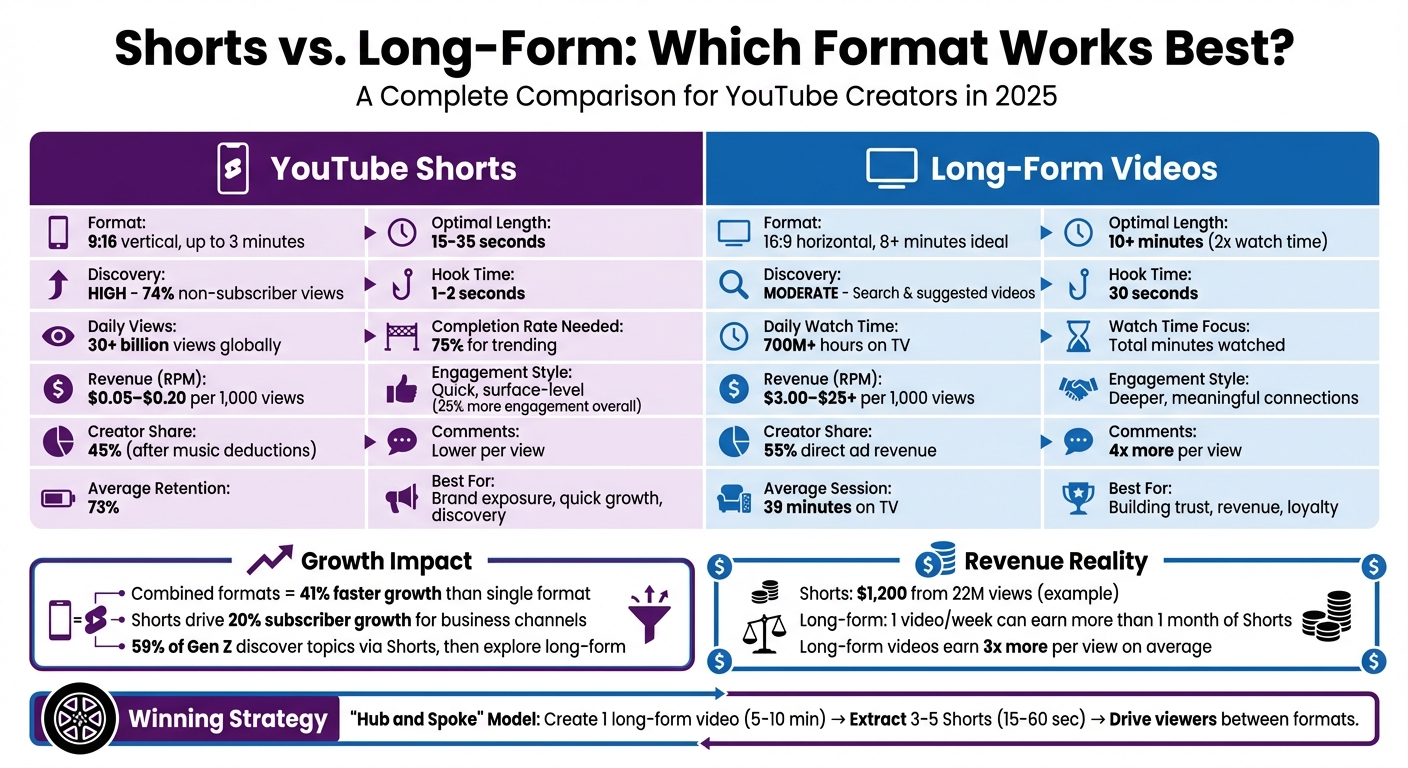
YouTube Shorts vs Long-Form Videos: Complete Comparison Guide
Shorts vs Long Form: Which Actually Grows a Channel in 2026?
Audience Reach: How Each Format Performs
YouTube uses separate algorithms for Shorts and long-form videos, each tailored to meet different viewing habits and engagement goals. The Shorts algorithm focuses on pulling in content based on users' watch history and trending topics, aiming for quick discovery and high engagement. On the other hand, the long-form algorithm prioritizes metrics like total watch time and average view duration to encourage viewers to stay on the platform longer.
Currently, Shorts account for about 30% of YouTube's total traffic. Long-form content, however, dominates the "living room" experience, with viewers watching over 700 million hours of YouTube content on TVs daily and averaging 39 minutes of watch time per session. These algorithmic differences highlight how Shorts and long-form videos attract and retain audiences in distinct ways.
YouTube Shorts: Quick Engagement, Rapid Growth
Shorts thrive on their ability to grab attention quickly, thanks to a streamlined algorithm that emphasizes "viewer satisfaction" over raw view counts. A key metric here is the Viewed vs. Swiped Away (VVSA) rate, which measures how often viewers watch a Short versus skipping it. High-performing Shorts typically maintain a VVSA rate between 70% and 90%. YouTube strategist Paddy Galloway explains:
YouTube will personalize recommendations of Shorts (i.e., look at watch history to see what someone likes) and show enjoyable Shorts that hold attention well to them.
To hit "trending" status, Shorts now need a completion rate of at least 75%, up from the previous 50% benchmark. Shorts with an average view duration of 50 to 60 seconds tend to perform exceptionally well, averaging around 4.1 million views, as they maximize total watch time. However, videos longer than 40 seconds often lose momentum - they're too long for a quick swipe but too short to build substantial watch time. The sweet spot for Shorts is now 15–35 seconds, balancing completion rates and loopability.
Long-Form Videos: Steady Engagement and Lasting Impact
While Shorts excel at rapid discovery, long-form videos focus on building deeper connections with viewers. These videos gain traction through search results, suggested videos, and the homepage, creating a more consistent flow of views. Videos longer than 10 minutes tend to have twice the average watch time compared to shorter ones and receive four times more comments per view than Shorts.
Retention is the algorithm's primary focus for long-form content. As Rene Ritchie, YouTube Creator Liaison, explains:
Creators often wonder why their videos aren't promoted, yet the algorithm is programmed to pull content based on viewer behavior.
Unlike Shorts, which often experience a sharp drop in engagement after their initial spike, long-form videos have a much longer shelf life. They continue to attract views over time, especially through search engine optimization. This makes them particularly appealing to the 59% of Gen Z users who use short-form videos to discover topics they later explore in long-form formats. In essence, Shorts ignite curiosity, but long-form videos provide the depth to satisfy it.
Revenue: How Each Format Makes Money
When it comes to revenue, Shorts and long-form videos operate under very different models, reflecting their distinct formats and audience behaviors. YouTube compensates creators for these formats using separate systems. For long-form videos, the approach is straightforward: creators earn 55% of the ad revenue generated directly from ads shown on their videos. Shorts, however, use a pooled revenue system. Here, all ad revenue from the Shorts feed is combined, music licensing costs are deducted, and creators receive 45% of their allocated share based on view percentages.
These models result in a noticeable gap in revenue per mille (RPM). Long-form videos typically earn an RPM between $3.00 and $6.00, with some premium niches exceeding $25. Shorts, on the other hand, generate a much lower RPM, ranging from $0.05 to $0.20 per 1,000 views. For example, in February 2025, creator Maldhound reported an average RPM of $5.50 for his 20–30 minute long-form videos, compared to just $0.18 for his Shorts. As TubeBuddy aptly described:
"Compared to long form videos, Shorts turn like the change you find down the side of the couch cushion."
This stark difference in RPM often influences creators' strategies, pushing them to weigh the benefits of high-volume Shorts against the more lucrative potential of long-form content. Below is a summary of the revenue features for each format:
Feature
YouTube Shorts
Long-Form Videos
Average RPM
$0.05 – $0.20
$3.00 – $6.00+
Creator Revenue Share
45% (after music deductions)
55%
Ad Types
Feed ads (between videos)
Pre-roll, Mid-roll, Post-roll, Overlays
Sponsorship Appeal
Awareness & Discovery
Detailed demos & trust-building
Shorts: Low Earnings Per View, High Volume
Shorts generate revenue through ads placed between videos in the Shorts feed. However, because earnings are pooled and shared among all creators, the per-view revenue is minimal. For instance, creator Jenny Hoyos gained 1.5 million subscribers with 90 Shorts but earned only $1,200 from 22 million views. Music licensing deductions further reduce earnings.
The key to making Shorts profitable lies in sheer volume. Creator Bennett Santora, who operates faceless short-form channels like AJAnimalKing, earns RPMs between $0.15 and $0.30 by consistently generating tens of millions of views each month. He also discovered that using music from Blastoff Media increased his Shorts RPM by an average of $0.15. For most creators, though, Shorts revenue serves as a supplementary income stream, with brand deals and merchandise often playing a larger role in their earnings.
Long-Form: Higher Earnings Per View and More Ad Options
Long-form videos, meanwhile, benefit from multiple ad placements, especially for videos longer than eight minutes, which qualify for mid-roll ads. These placements significantly increase earnings per view. Additionally, long-form videos attract advertisers in high-paying niches like finance, B2B, and technology - industries willing to spend more to engage attentive audiences. For example, one music channel saw a 52% revenue boost by optimizing its content for 4K horizontal viewing on TV screens.
Beyond AdSense, long-form content offers creators opportunities for premium sponsorships. Brands often prefer this format for in-depth product demonstrations, tutorials, and reviews, as the extended runtime allows for trust-building and thorough explanations. In February 2025, Maldhound shared that a single long-form video, live for just one week, earned him more revenue than an entire month of Shorts. Moreover, long-form videos tend to have a longer shelf life, with search optimization enabling them to generate revenue well after their initial release. This creates an ongoing and compounding income stream for creators.
Engagement: How Viewers Interact With Each Format
Engagement varies greatly between YouTube Shorts and long-form videos. While both formats have their strengths, they cater to different viewer behaviors. On average, YouTube Shorts receive 25% more engagement than long-form videos. However, this engagement is typically surface-level - think quick likes and fleeting views - whereas long-form videos generate four times more comments per view, showing that viewers take the time to reflect on and respond to what they've watched.
This difference boils down to how each format is consumed. Shorts encourage rapid scrolling and split-second interactions, while long-form videos demand a greater time commitment, leading to deeper viewer involvement. As a result, Shorts are great for attracting new audiences, but long-form videos are better at fostering loyal communities. Let’s dive into how these engagement patterns play out across both formats.
Shorts: Quick Engagement, Limited Depth
Shorts thrive on fast, surface-level interactions. They rack up likes quickly but tend to generate fewer comments per view. Viewer retention for Shorts averages around 73%, meaning a typical 60-second Short holds attention for about 43 seconds. This highlights the fleeting nature of engagement with Shorts.
For business channels, incorporating Shorts can accelerate subscriber growth by 20%. However, these subscribers often don’t stick around as loyal viewers. Layla Torkmann from Brandwatch explains:
Shorts are fleeting and often less effective at building deeper connections with your audience... its surface-level nature makes it harder to establish lasting relationships.
While Shorts are excellent for boosting visibility and attracting attention, they’re less effective at creating a sense of community or long-term loyalty.
Long-Form: Creating Deeper Connections
Long-form videos, on the other hand, excel at building trust and fostering meaningful relationships. When viewers dedicate 10, 20, or even 30 minutes to a video, they’re not just consuming content - they’re engaging with it on a much deeper level. This is evident in the comment sections, where viewers leave thoughtful feedback, ask questions, and participate in meaningful discussions.
While Shorts may grab the initial click, long-form videos are where connections are formed. As Iryna Avramenko from AIR Media-Tech puts it:
Shorts will get you the initial view, but long-form will get you the connection and the trust. And that's what you need to build a true community around your channel.
sbb-itb-08cadfc
When to Use Each Format
Deciding between Shorts and long-form videos comes down to your goals. Shorts are perfect for quick brand exposure and discovery. With over 1.5 billion monthly active users and more than 30 billion daily views, Shorts can get your content in front of huge audiences almost instantly.
Long-form videos, on the other hand, are ideal for building trust and driving conversions. A well-crafted 5–10 minute video can address customer objections and showcase value, making it a great fit for complex or high-ticket products. Long-form content also shines when it comes to tutorials, in-depth reviews, or educational topics that require a detailed approach.
The winning strategy in 2026 blends both formats. Creators who combine Shorts with long-form content often see a dramatic boost in subscriber growth compared to those who stick to just one format. For example, in 2025, creator MacDannyGun used viral Shorts to guide viewers toward long-form videos, gaining 670,000 new subscribers in the process. Similarly, Pikameo Gameplay balanced Shorts for reach and long-form for engagement, growing to 35,000 subscribers in just two months.
Try the "Hub and Spoke" model: Start with a 5–10 minute long-form video, then create 3–5 vertical Shorts (15–60 seconds each) by pulling out key highlights. Use pinned comments and end screens to direct viewers between formats. This strategy creates a seamless cycle where Shorts attract new viewers, and long-form videos deepen their connection and drive conversions.
If you're unsure about what topics will connect with your audience, tools like Outlier can simplify the process. It analyzes competitor content and trends to generate personalized video ideas, complete with suggested titles, hooks, and confidence scores, all in just two minutes. This data-driven method takes the guesswork out of choosing what to create for each format.
Finally, beyond crafting a strong strategy, it’s crucial to understand the technical aspects of each format. Knowing the specifics can streamline your production process and ensure better results.
Technical Requirements and Limitations
YouTube Shorts are designed with a 9:16 vertical aspect ratio and a resolution of 1920x1080 pixels. As of October 15, 2024, Shorts can run up to 3 minutes. However, if you’re using copyrighted music, the duration is capped at 60 seconds, while royalty-free music allows for the full 3 minutes. Videos that don’t meet the 9:16 ratio are automatically categorized as standard YouTube videos.
Long-form videos, on the other hand, typically use a 16:9 horizontal aspect ratio and support resolutions as high as 4K or even 8K. To ensure a video under 3 minutes is treated as long-form instead of a Short, you need to stick to a wide aspect ratio like 16:9. This format offers more flexibility in terms of production quality and viewer experience.
Production methods differ significantly between Shorts and long-form videos. Shorts uploaded via mobile are limited to a 1080p resolution, while long-form videos don’t have this restriction. For Shorts, YouTube provides built-in tools like multi-segment capture, filters, text-to-speech, and speed adjustments. In contrast, long-form videos often require external editing software to handle more complex scripting and post-production tasks.
Content ID claims can complicate Shorts. Any Short over one minute that receives a Content ID claim is blocked globally and loses monetization eligibility. Additionally, the Shorts Audio Library imposes limits on music usage: most tracks can be used for up to 90 seconds in a 3-minute Short, though some are restricted to just 30 or 60 seconds.
Hook timing is another key difference between formats. For Shorts, you need to grab attention within the first 1–2 seconds, while long-form videos offer around 30 seconds to engage viewers. Research by Jenny Hoyos revealed that top-performing Shorts averaged 34 seconds of viewer engagement, underscoring the importance of an immediate and compelling hook.
Mastering these technical requirements and limitations is essential to maximizing the potential of each format.
Conclusion
Based on the strategies and insights shared earlier, tailoring your content approach to match your channel's specific goals is key. There’s no universal format that guarantees success - your choice should reflect what you’re aiming to achieve. For instance, if your priority is to boost brand visibility and attract new subscribers quickly, Shorts are a powerful option, with over 15 billion daily views globally. On the other hand, if your focus is on building a steady revenue stream and cultivating deeper connections with your audience, long-form videos excel, offering up to three times higher earnings per view.
An effective approach for 2025 is the "Hub and Spoke" strategy, which uses long-form videos as a foundation and repurposes them into Shorts to create a discovery funnel. A great example of this in action is creator Amelka Karamelka, who implemented this model across 18 localized channels in 2025, resulting in 5.6 million subscribers and 288 million views.
The key is aligning your content format with your goals. Use Shorts for quick engagement and lead generation, and lean on long-form videos to establish authority and drive meaningful conversions. Tools like Outlier can streamline this process by analyzing competitor content and generating personalized video ideas - including titles and hooks - in just two minutes. The most successful YouTube creators aren’t choosing between formats; they’re combining both strategically to maximize their reach, revenue, and audience loyalty.
FAQs
How can I use Shorts and long-form videos together to grow my channel?
To grow your YouTube channel, think of YouTube Shorts as a way to draw in viewers and long-form videos as a tool to keep them engaged. Start by crafting Shorts that showcase the most captivating or intriguing moments from your longer videos. Make sure to include a strong call-to-action like, “Check out the full video for more!” Use features like end screens, pinned comments, and playlists to guide viewers seamlessly to your long-form content.
Another effective approach is to repurpose standout clips from your long videos into Shorts. This not only helps attract new viewers but also reinforces the core themes of your channel. Keep an eye on which Shorts perform the best in terms of clicks and engagement, and use that insight to refine your long-form video strategy - especially when it comes to titles and thumbnails.
By consistently linking these two formats - using Shorts to tease or promote your long-form videos and longer content to deliver deeper insights - you can create a strategy that drives more views, boosts engagement, and grows your subscriber base.
How do I decide between YouTube Shorts and long-form videos for my content?
Choosing between YouTube Shorts and long-form videos boils down to your goals and what resonates with your audience.
Shorts are bite-sized videos, under 60 seconds, designed to grab attention quickly - perfect for mobile users. They work well for trends, teasers, or quick highlights and can help you grow your subscriber base in no time. However, keep in mind that monetization opportunities for Shorts are currently more limited compared to longer videos.
On the other hand, long-form videos - typically over 8 minutes - are ideal for deeper dives. Whether it's storytelling, tutorials, or timeless topics, these videos allow for more detailed content. They also come with perks like better SEO, higher ad revenue potential, and stronger audience connections. While they require more effort to produce, the payoff can be significant if you're aiming to establish authority or generate income.
The best approach often lies in combining both formats. This balance lets you tap into the quick reach of Shorts while leveraging the depth and revenue potential of long-form content.
How does monetization differ between YouTube Shorts and long-form videos?
YouTube Shorts and long-form videos operate under different monetization systems. Shorts primarily depend on the YouTube Shorts Fund, which rewards creators based on their Shorts' performance, such as the number of views. Unlike long-form videos, Shorts don’t use traditional ad formats like pre-roll or mid-roll ads, which limits how much revenue they can generate.
In contrast, long-form videos benefit from YouTube’s complete range of ad formats, including pre-roll, mid-roll, display, and overlay ads. Creators typically earn 55% of the ad revenue from these videos. Beyond ad earnings, long-form content creators can tap into additional revenue streams like channel memberships, Super Chat, and merch shelves, making it a more lucrative option overall.


