

How Trends Shape Viewer Behavior on YouTube
YouTube trends influence not just what people watch but how they engage with content. Key takeaways include:
- Creators drive viewer behavior: 54% of viewers prefer creators' breakdowns of major events over the events themselves.
- Multi-format consumption is rising: 87% of viewers consume at least four formats - Shorts, long-form videos, live streams, and podcasts.
- Trends boost engagement: Trending content can lead to 40% higher engagement and 60% higher click-through rates than evergreen videos.
- Niche interests dominate: Topics like generative AI (1.7B views in 2023) and VTubers (1.5B monthly views) show how fragmented audiences shape trends.
- Algorithms amplify trends: YouTube's system promotes content based on engagement, relevance, and audience satisfaction.
Creators who act quickly on trends can improve watch time, retention, and audience growth. Tools like YouTube Analytics and Outlier help identify trends, track performance, and refine strategies. Balancing trend-driven content with evergreen videos ensures long-term success.
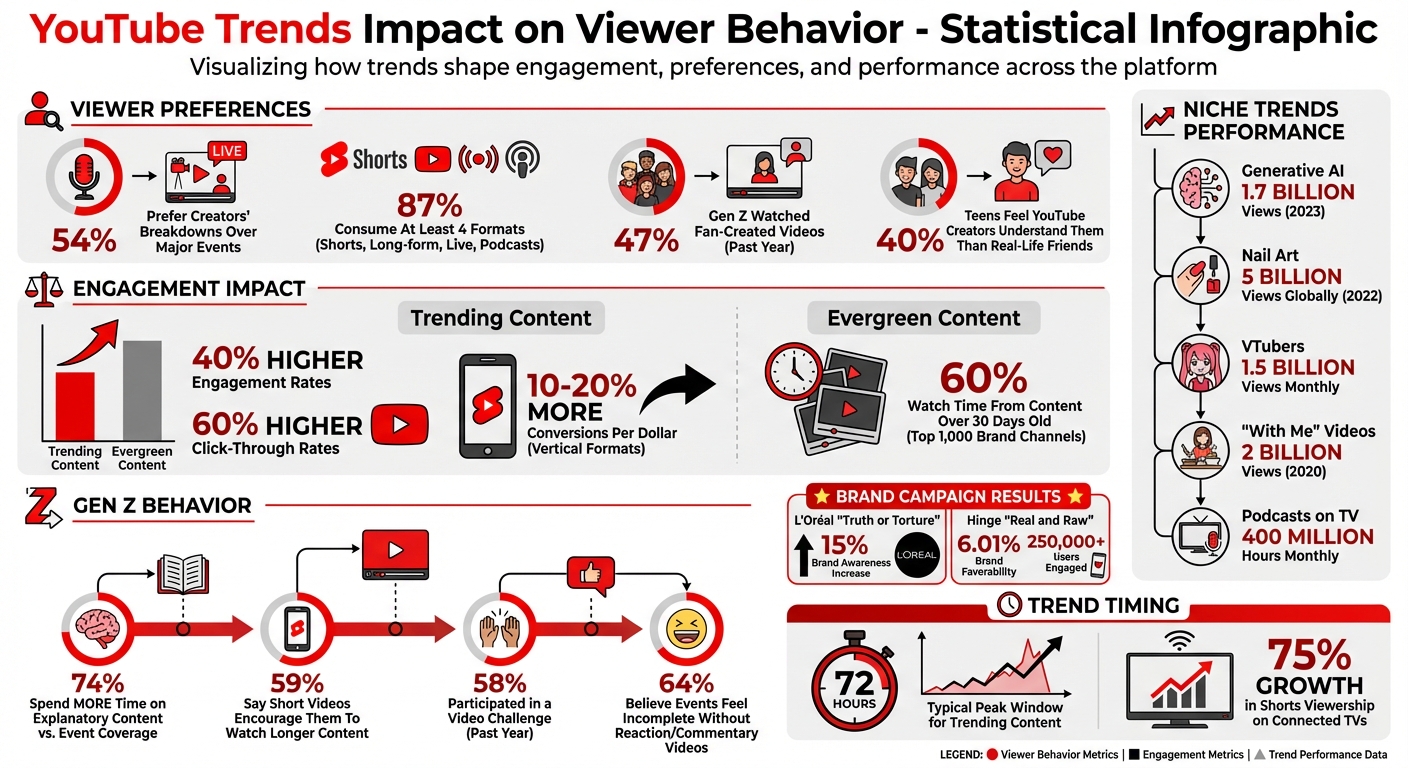
YouTube Trends Impact on Viewer Behavior: Key Statistics and Engagement Metrics
How Trends Affect What Viewers Watch
What Are YouTube Trends?
YouTube trends cover everything from viral sensations to seasonal content and niche interests. These trends highlight what specific communities care about at any given moment. For instance, videos about generative AI tools racked up an impressive 1.7 billion views in 2023. Meanwhile, nail art videos hit a staggering 5 billion views globally in 2022. These examples aren’t just random hits - they reflect the diverse interests of different audience segments.
Take Virtual Humans (VTubers), for example. They attract over 1.5 billion views every month. Then there's analog horror, a genre that uses eerie, vintage VHS-style effects in short videos. These niche patterns show how trends today cater to more specific, fragmented audiences. This diversity in trending topics helps explain why viewers gravitate toward certain content.
Why Viewers Choose Trending Content
Trending content pulls in viewers for several reasons: curiosity, relevance, and the influence of social proof. Trending topics create a sense of urgency and a desire to be part of the conversation. This might explain why nearly half (47%) of Gen Z viewers have watched videos created by fans of specific artists, public figures, or content over the past year.
Social proof also plays a big role. When a video has a trending badge or high view counts, it signals that the content is worth watching. And for many younger viewers, the connection runs even deeper - 40% of teens feel that their favorite YouTube creators understand them better than their real-life friends. These behaviors heavily influence YouTube's recommendation system, which works to match trending content with individual viewer interests.
How YouTube's Algorithm Promotes Trends
YouTube’s recommendation system isn’t about randomly pushing videos - it’s about finding the right videos for the right viewers. The platform’s algorithm evaluates factors like engagement, watch history, and viewer preferences. Videos that perform well early on are given a boost, and recommendations are fine-tuned to align with external factors like seasonal events.
Todd Beaupré, YouTube’s Senior Director of Growth and Discovery, puts it this way:
"We're trying to understand not just about the viewer's behavior and what they do, but how they feel about the time they're spending."
This approach prioritizes viewer satisfaction over simple click metrics. By promoting content that genuinely resonates, YouTube keeps its audience engaged and coming back for more. These dynamics are key to understanding how creators can adapt their content to align with viewer preferences.
How Trends Improve Watch Time, Retention, and Engagement
Increasing Watch Time with Trends
Trending content has a unique ability to keep viewers engaged for longer periods. For example, the top 1,000 brand channels generate 60% of their watch time from content that’s over 30 days old. This shows that trends can give content a longer shelf life, keeping audiences coming back.
Take "With Me" videos as an example. These videos, which offer viewers a sense of virtual companionship, racked up over 2 billion views in 2020, with 79% of viewers reporting a deeper connection through this format.
Short-form content is another major player. It’s especially effective with Gen Z, with 59% of users stating that short videos encourage them to dive into longer content. And let’s not forget podcasts - 400 million hours of podcasts are consumed monthly on televisions, further proving that trending formats can hold attention for extended periods.
When viewers stick around longer, it naturally improves retention, which is the next piece of the puzzle.
Improving Retention Rates
Retention rates thrive when content aligns with what audiences are buzzing about. For instance, 74% of Gen Z spends more time on content that explains a topic rather than just covering the event itself.
Certain trending genres are particularly effective at keeping viewers engaged. Challenge videos are a standout example. These build suspense as they progress, reducing the chances of viewers dropping off mid-video. Anne Marie Nelson-Bogle, YouTube’s VP of Ads Marketing, highlights this point:
"The challenge genre wins by building suspense to retain audiences, especially younger viewers."
The numbers back this up. 58% of Gen Zers participated in a video challenge in the past year. Reaction and commentary videos are another big draw - 64% of viewers believe that events like the Oscars or Coachella feel incomplete without them. Creators who offer fresh takes on trending events can hold attention better than those who simply recap the event.
Better retention naturally paves the way for stronger engagement, which is where trends really shine.
Driving More Engagement
When watch time and retention improve, engagement often follows. Trending topics can supercharge key metrics, delivering up to 40% higher engagement and 60% higher click-through rates compared to evergreen content.
Brand campaigns leveraging trends have seen impressive results. For instance, L'Oréal’s "Truth or Torture" challenge in 2025 increased brand awareness by 15%. Similarly, Hinge’s "Real and Raw Conversations" campaign boosted brand favorability to 6.01% and engaged over 250,000 users.
Trending formats also benefit from algorithmic boosts. High engagement signals to platforms that the content is worth promoting, creating a cycle of growth. Additionally, vertical formats like YouTube Shorts are outperforming traditional landscape videos, delivering 10% to 20% more conversions per dollar spent.
How to Identify and Analyze Trend-Driven Viewer Behavior
Step 1: Spot Trending Topics in Your Niche
Head over to YouTube Studio's Trends tab to uncover top searches and breakout videos that have captured your audience's attention over the last 28 days. For real-time updates, check out the YouTube Trending page, which refreshes every 15 minutes to reflect what’s grabbing viewers' interest.
Don’t stop there - explore platforms like TikTok, X, and Instagram, where trends often surface before making their way to YouTube. Tools like Google Trends can also help. Apply the "YouTube Search" filter to see how interest in a topic evolves over time, and use the "Rising" filter to pinpoint searches experiencing a surge in popularity.
Another key step is identifying content gaps. Look for areas where existing videos are outdated or lack quality. YouTube even flags these opportunities by tracking videos that have been watched over 1,000 times weekly in the last 28 days. Once you’ve identified trending topics, it’s time to analyze their impact on your audience.
Step 2: Monitor Analytics for Behavioral Shifts
After spotting trends, dive into your analytics to see how they’re resonating with your audience. Pay attention to subscriber splits and keep an eye out for outlier videos - those pulling in 5 to 10 times more views than your average content.
Trends can also shake up your audience demographics, so track any shifts in who’s watching your videos. Engagement metrics like likes, comments, shares, and both absolute and relative watch times can offer deeper insights into how viewers are interacting with your content.
Once you’ve gathered this data, you’ll have a clearer picture of how trends are influencing your channel.
Step 3: Compare Viewer Behavior Before and After Trends
Leverage YouTube Analytics to group videos by format or topic, then conduct 90-day performance reviews to identify what’s driving growth. This will help you determine whether trend-based content is outperforming your usual uploads.
Dive into your comment sections and key engagement timestamps to spot changes in how viewers are reacting. To measure success, compare the performance of trend-driven videos against your regular content by analyzing click-through rates, engagement levels, and multiplier scores.
How to Adapt Your Content to Current Trends
Predicting and Planning for Upcoming Trends
Stay ahead of the curve by spotting trends early. Platforms like TikTok's Creative Center, X, Reddit, and YouTube's Research Tab are goldmines for finding trends before they saturate YouTube. Make it a habit to check these daily to identify content gaps - search terms where viewers are looking for answers but can't find quality content. To confirm whether a trend is gaining momentum or losing steam, use Google Trends with the "YouTube Search" filter.
Another smart move is to scan competitor comment sections. These often reveal questions or topics that viewers want but aren't being addressed. For example, in 2024, gaming creator Ajjubhai (Total Gaming) tapped into his audience's requests for a face reveal. This pivot to on-camera content racked up over 900 million views in a single year.
With these insights, you'll be equipped to create content that meets the evolving demands of your audience.
Creating Content Around Trends
Once you've identified a trend, the next step is to create content that stands out. Tailor trends to fit your channel's style and expertise. As Universal Music for Creators puts it:
"The best way to benefit from an emerging video trend is to create the best and most engaging content available on the particular subject. Try to give your viewers insights, opinions, and facts no other channel gives them".
Focus on specific niches within broader trends. For instance, if "AI tools" is trending, narrow it down to something like "AI tools for real estate photography" if that's your area of expertise. This approach keeps your content relevant while maintaining your unique identity. Timing is key - trend-driven videos often see up to 40% higher engagement rates compared to evergreen content, but trends typically peak within a 72-hour window.
Leverage YouTube Shorts to test ideas quickly. With Shorts viewership on connected TVs growing by 75%, a 45-second video can help you gauge audience interest before committing to a full-length production. If a Short performs well, link it to a longer, more detailed video to keep viewers engaged.
Using Outlier for Data-Driven Trend Insights
Outlier provides actionable insights by analyzing competitor channels. Simply input a competitor's URL, and the tool will review 90 days of content performance to uncover what’s working in your niche.
It highlights standout videos - those performing 10 times better than a channel's average - offering a roadmap for creating content that resonates. Outlier even delivers personalized video ideas with suggested titles, hooks, and confidence scores, all based on proven patterns of view velocity. The best part? You can access these insights in just two minutes without needing a subscription or linking your YouTube account.
This data-driven strategy allows you to pinpoint high-demand, low-competition keywords before they become oversaturated. By combining trend analysis with thoughtful content planning, you can create videos that not only align with audience interests but also strengthen your channel’s identity. It’s a winning formula for staying relevant and impactful.
sbb-itb-08cadfc
How to Measure the Results of Trend-Based Content
Monitoring Key Metrics Over Time
YouTube Analytics provides the tools you need to evaluate how trend-driven videos perform. Start by checking the Overview tab for real-time views and comparing them to your usual performance range. This helps you distinguish between fleeting spikes and trends with lasting impact.
Pay attention to three key areas: Reach (Impressions, Click-Through Rate, Unique Viewers), Engagement (Watch Time, Average View Duration, Audience Retention), and Audience Growth (New Viewers). These metrics reveal whether your content is effectively reaching viewers, keeping them engaged, and attracting new audiences.
Videos that outperform your baseline metrics are a good indicator of a trend’s influence. The Content tab can show how impressions translate into watch time, while the Trends tab helps identify content gaps where demand isn’t being met.
Finally, compare these metrics to see how your trend-based videos measure up against your regular uploads.
Comparing Performance Data
Take a close look at how trend-based content performs compared to evergreen videos. Use the Advanced Mode in YouTube Studio to export data and directly compare metrics. Trend-driven videos often experience a surge in performance, with some seeing up to a 60% higher click-through rate initially and engagement rates increasing by as much as 40% during a trend’s peak.
Metric
Trend-Based Content
Non-Trend/Evergreen Content
Initial Reach
Higher due to search spikes and algorithm boosts
Steady; relies on subscribers and long-term SEO
Watch Time Source
Primarily "New Viewers" and "Search"
More "Returning Viewers" and "Browse Features"
Longevity
Short-lived; relevance often fades after 72 hours
Sustained; contributes to long-term watch time
Review the "New vs. Returning" viewer data to understand if your trend-driven videos are reaching new audiences beyond your subscriber base.
Refining Your Content Strategy
Use these insights to fine-tune your content approach. By analyzing performance differences, you can adjust your strategy to focus on trends that show real potential. Group your trend-based videos into categories in YouTube Analytics to spot patterns across multiple uploads, rather than relying on data from individual videos. Check audience retention to see if viewers drop off early - this could mean your video isn’t delivering on the expectations set by its title or thumbnail.
The Audience Interest card in the Trends tab highlights interest levels (ranging from very low to very high) for specific search terms over the past 28 days. This data helps you decide which trends are worth pursuing and which ones to skip. If a trend generates high engagement but fades quickly, it might not justify a long-term strategy shift.
Compare the demographics of viewers drawn to trend-driven content with your existing audience to ensure long-term alignment. Dive into the comments section to uncover content gaps and gather ideas for future videos. This feedback loop allows you to turn one-off experiments into reliable formats that keep viewers engaged even after the initial trend fades.
New & Returning Viewers [NEW YouTube Analytics Feature]
Conclusion
Trends play a major role in shaping viewer behavior on YouTube, but capitalizing on them requires quick, strategic action. Trending topics typically stay relevant for just 72 hours. That said, not every trend is worth pursuing - especially if it doesn’t align with your niche or contribute to long-term growth.
Data shows that jumping on emerging trends can boost engagement rates by as much as 40% compared to evergreen content. However, evergreen videos still hold their ground, with over 60% of organic watch time for top channels coming from content that's more than 30 days old. The key is finding a balance: combine timely, trend-driven videos with evergreen content to maximize impact.
This approach highlights the importance of acting quickly but with purpose.
"Success is no longer about producing good content; it is about producing hyper-relevant, immediate content that aligns precisely with shifting audience interests." - ReelMind.ai
Leverage data to make informed choices. Tools like Outlier simplify trend analysis, delivering personalized video ideas complete with confidence scores and supporting data in just two minutes. This kind of speed and precision can make all the difference in today’s fast-paced content landscape.
FAQs
How do YouTube trends impact viewer engagement and CTR?
YouTube trends offer a window into what’s catching viewers’ attention right now, making them a goldmine for boosting engagement and click-through rates (CTR). When creators tap into trending topics - whether it’s the latest memes, viral challenges, or breaking news - they’re more likely to grab eyeballs. This often leads to higher CTRs, sometimes even surpassing YouTube’s typical range of 2%–10%.
The platform’s algorithm is designed to reward videos that perform well in key areas like CTR, watch time, and viewer satisfaction. These factors help videos gain more visibility across home feeds, search results, and the coveted suggested video section. By crafting content that aligns with trending interests, creators not only draw in more clicks but also keep viewers watching longer - giving their videos an extra performance boost.
To stay ahead of the curve, tools like Outlier can be a game-changer. They help creators identify rapidly growing topics and provide data-backed suggestions for titles, thumbnails, and hooks. This strategy transforms trends into a powerful feedback loop of higher impressions, increased engagement, and steady subscriber growth.
How does YouTube’s algorithm promote trending videos?
YouTube’s algorithm is a driving force behind the promotion of trending videos. It evaluates factors like watch time, click-through rates, user satisfaction, and real-time viewing patterns to pinpoint content that’s rapidly gaining traction. Once identified, these videos are showcased prominently on the Home page, “Up Next” suggestions, and the Shorts feed, making it easier for trends to catch fire across the platform.
With the recommendation system influencing around 70% of what users watch, creators have a real opportunity to tap into this system. By keeping an eye on emerging trends and fine-tuning elements like video titles, opening hooks, and topics, you can boost the likelihood of your content appearing in YouTube’s recommendation streams.
How can YouTube creators spot and make the most of new trends?
To keep up with the latest YouTube trends, it’s essential to stay alert to signals both on the platform itself and across the broader internet. Start by using tools like YouTube’s trending section and Google Trends (set specifically to YouTube search) to track rising topics. YouTube Culture & Trends reports are another great resource for spotting popular creator formats, viral music, or even shopping-related content. And don’t overlook platforms like TikTok or Pinterest - trends often emerge there before making their way to YouTube.
When you identify a trend, timing is everything. Move quickly and bring something new to the table. Whether it’s a fresh perspective, unique data, or personal insights, your content should offer something others haven’t yet explored. Tools like Outlier can assist in crafting data-driven video ideas, titles, and hooks tailored to your niche, helping you align your content with the trend. Wrap it all up with an eye-catching thumbnail, SEO-friendly tags, and a well-timed upload schedule to make the most of the trend’s momentum.


