

Ultimate Guide to Competitor Analysis for YouTube
Competitor analysis on YouTube helps you learn what works for other creators in your niche. By studying their strategies - like video formats, titles, thumbnails, and audience engagement - you can find content gaps and improve your channel’s performance. This guide breaks down a simple 4-step process:
- Identify competitors: Use tools like YouTube Studio or Outlier to find channels in your niche.
- Analyze metrics: Focus on engagement ratios, watch time, and standout videos.
- Study content strategies: Look at video formats, upload patterns, and hooks.
- Generate ideas: Use insights to create data-backed video concepts.
Tools like Outlier ($15/month) make this process easier by automating analysis and suggesting actionable ideas. Whether you’re tracking keywords, engagement, or audience feedback, competitor analysis can help you create better videos and grow your channel.
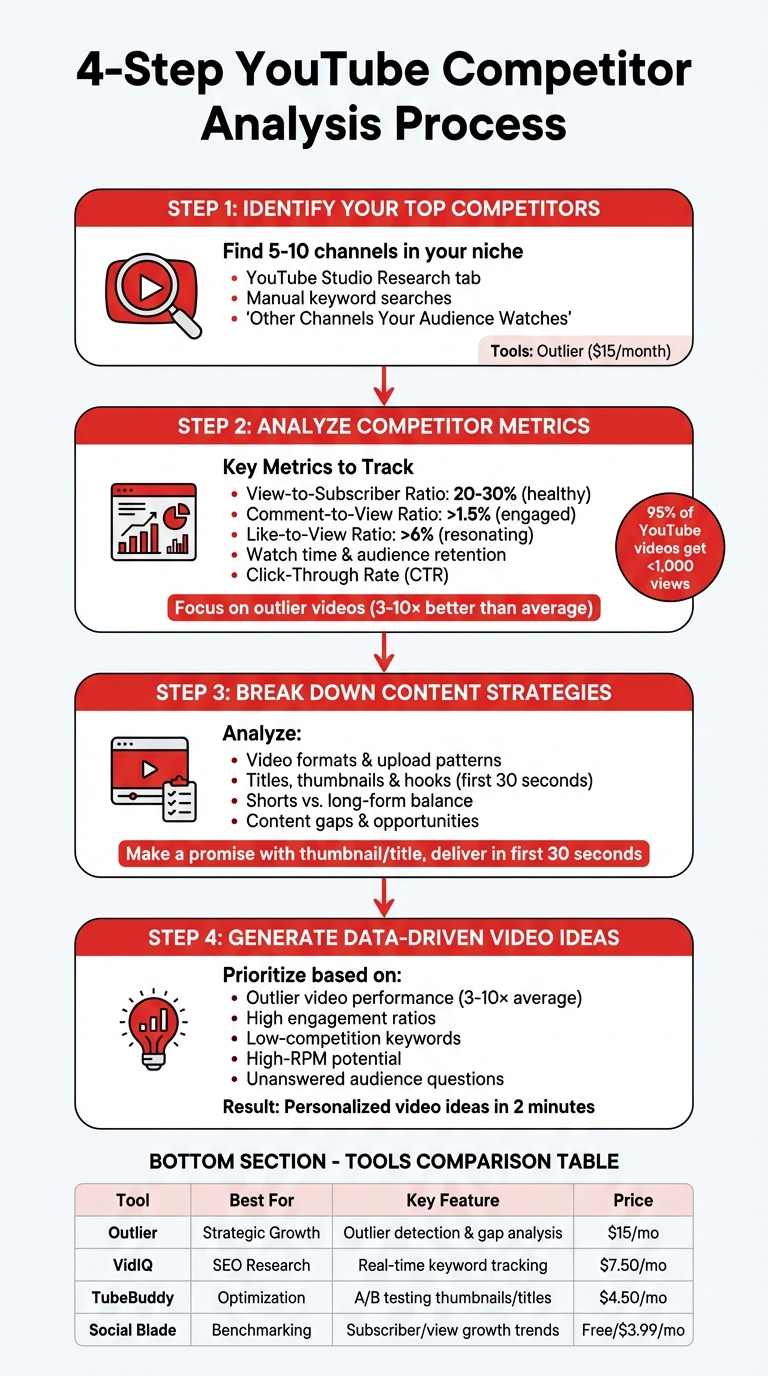
4-Step YouTube Competitor Analysis Process for Channel Growth
Step 1: Identify Your Top Competitors
Finding Competitors in Your Niche
Your competition might not be as obvious as you think. Lydia Sweatt, Blog Manager at vidIQ, explains it well:
"Competition is relative. Most creators aren't competing with MrBeast - at least not directly. It's the people standing on either side of them that they compete with."
To narrow your focus, categorize your competitors into direct, indirect, or aspirational groups. Aim to create a list of 5 to 10 channels to keep your analysis focused and actionable.
A quick way to start is by using YouTube Studio's Research tab. Head to Analytics > Research > Your viewers' searches to uncover the search terms your audience is using. Then, look up those terms to see which channels dominate the results. Another helpful feature is the "Other Channels Your Audience Watches" section in the Audience tab. This shows channels your viewers have interacted with over the past seven days.
You can also analyze search results manually. Type niche-specific keywords into YouTube's search bar and observe the top-ranking results and "Up Next" recommendations. Channels that frequently appear in these spots are worth adding to your list.
Once you've done some groundwork, consider using tools to speed up the process.
Using Tools to Find Competitors Faster
Manually hunting for competitors can be tedious, but tools like Outlier (https://outlier.so) simplify the process. By entering competitor channel URLs, Outlier instantly benchmarks their performance against yours. For $15/month, OutlierKit offers features like outlier detection and niche gap analysis, helping you identify videos that perform 3–10× better than a channel's average - giving you a clear picture of what's resonating in your niche.
This tool saves hours of manual research by delivering data-driven insights. When assessing competitors, don't just focus on subscriber counts. Instead, pay attention to their Views-to-Subscribers (V/S) ratio. A healthy V/S ratio of 20–30% signals strong audience engagement, while lower numbers might indicate content that’s missing the mark. Keep in mind that 95% of YouTube videos get fewer than 1,000 views, so finding what works can give you a real edge.
Step 2: Analyze Competitor Metrics and Content Performance
Key Metrics to Track
After pinpointing your competitors, it’s time to dive deeper into the numbers that genuinely reflect their success. Subscriber counts and total views are just surface-level data. To truly understand audience engagement, focus on engagement ratios and performance trends.
Start by examining the View-to-Subscriber (V/S) ratio. A solid benchmark is between 20% and 30%. If it’s lower, it might indicate that the audience isn’t consistently engaging with new uploads. Next, shift your attention to engagement ratios instead of raw numbers. A comment-to-view ratio above 1.5% signals an active and engaged community, while a like-to-view ratio higher than 6% suggests the content is resonating well with viewers.
Metrics like watch time and audience retention are essential for understanding how effectively videos hold viewer attention - something YouTube’s algorithm heavily prioritizes. Additionally, track the Click-Through Rate (CTR) and evaluate how thumbnails are performing. These metrics can reveal what’s driving initial clicks. Don’t forget to analyze content strategy metrics, such as posting frequency and the balance between Shorts and long-form videos. These details provide insights into how competitors are adapting to YouTube’s evolving trends.
Pay special attention to outlier videos - those that perform 3 to 10 times better than the channel’s average. These standout videos can uncover which topics, formats, or styles are striking a chord with audiences, offering valuable clues for your own content strategy.
How Outlier Helps with Metrics Analysis
Analyzing all these metrics manually can be overwhelming, but tools like Outlier (https://outlier.so) simplify the process significantly. Outlier automatically identifies top-performing videos from the last 90 days of a competitor’s content. Instead of spending hours calculating performance multipliers or sifting through spreadsheets, you get instant insights into metrics like view velocity, trending topics, and proven content patterns - all in just two minutes.
What sets Outlier apart is its ability to go beyond basic metrics. It provides script-level insights, breaking down why specific hooks or segments worked so well. On top of that, it delivers personalized video ideas, complete with suggested titles, hooks, confidence scores, and supporting data tailored to your channel. This eliminates the guesswork, allowing you to reverse-engineer what’s working for your competitors and focus on strategies that are backed by data.
Step 3: Break Down Competitor Content Strategies
Analyzing Video Formats and Upload Patterns
Take a close look at how your competitors structure their videos. Pay attention to elements like the length of their hooks, the rhythm of their segments, and any repeatable patterns they use. Also, study how often they upload - whether it's weekly, monthly, or in binge-worthy batches. Noticing trends like a shift from standalone videos to series or experimenting with formats like "Top 5 Things You're Doing Wrong" can highlight tactics that are working for them.
Another key area to explore is how they balance YouTube Shorts with longer videos. Many creators now use Shorts to funnel traffic to their longer uploads, creating a seamless content ecosystem. Organize their videos into categories like tutorials, vlogs, reviews, interviews, or even memes. Then, review their upload history over the past six months to identify patterns you might incorporate into your strategy. Lastly, dive into how they grab attention with their titles, thumbnails, and opening hooks.
Evaluating Titles, Thumbnails, and Hooks
Look for recurring patterns in their titles. These might include using numbers, posing questions, or leveraging emotional triggers. Similarly, examine their thumbnails for consistent elements like bold text, action shots, close-ups, or specific color schemes.
Now, focus on the first 30 seconds of their videos. Do they deliver on the promise made by their title and thumbnail? As Cody Schneider puts it:
"Make a promise with the thumbnail and title... deliver on that promise in the first 30 seconds." - Cody Schneider
Watch how competitors keep viewers engaged in those crucial opening moments. Techniques like jump cuts, first-person storytelling, humor, or emotional appeals can all play a role. Pay extra attention to outlier videos - those that perform 3 to 10 times better than the channel's average. Reverse-engineering the title and thumbnail combinations that made these videos go viral can offer valuable insights. Once you understand their winning strategies, look for gaps they might be leaving open.
Spotting Content Gaps and Opportunities
Identify where competitors are falling short. Are there issues with their tone, language, or video format? Look for adjacent keywords or overlooked topics that could represent low-competition, high-relevance opportunities. Tools like Outlier (https://outlier.so) can help by pinpointing underserved niches, high-RPM keywords, and even analyzing comment sections to highlight unanswered viewer questions or requests. This kind of rapid gap detection gives you the chance to jump on opportunities before your competitors even realize they're there.
Step 4: Generate and Prioritize Data-Driven Video Ideas
Using Outlier to Generate Personalized Video Ideas
Transform competitor analysis into actionable video concepts with Outlier (https://outlier.so). This tool simplifies the process, delivering tailored video ideas in under two minutes. By analyzing the past 90 days of performance data, it identifies videos that are outperforming the average by 3× to 10×.
Outlier provides suggested titles, hooks, confidence scores, and insights like view velocity. It leverages AI to analyze millions of videos, pinpointing high-RPM keywords that can significantly boost ad revenue. Gautham, a YouTube Strategist, shared:
"OutlierKit is the first tool that actually improved our view counts almost instantly. The competition analysis revealed gaps we never knew existed." – Gautham, YouTube Strategist
The platform excels at uncovering underserved content areas by identifying gaps in competitor coverage. These "blue ocean" opportunities allow you to create content in niches with less direct competition. Its three-step automated workflow - analyzing competitor channels, breaking down why their videos succeed (hooks, pacing, retention), and applying those insights to your strategy - saves hours of manual research.
Once you've generated these personalized video ideas, the next step is to prioritize them using data-backed insights from competitors.
Prioritizing Ideas Based on Competitor Insights
To make the most of your competitor research, focus on topics tied to outlier videos - those that performed 3× to 10× better than the average content on a competitor's channel. These represent clear breakout opportunities. However, don't rely solely on raw view counts. Instead, dig deeper into engagement metrics. A comment-to-view ratio above 1.5% and a like-to-view ratio exceeding 6% are strong indicators of audience connection.
Pay attention to areas where competitors excel in reach but falter in retention. Look for friction points or unanswered questions in their comment sections - these can guide you to content gaps worth exploring. Additionally, study the "keyword spine", which includes the root phrases in titles, descriptions, and tags. This can help you uncover adjacent, low-competition keywords that others may have overlooked. As Andy, a YouTube Creator, remarked:
"Finally, a tool that finds keywords I can actually rank for instead of competing with MrBeast!" – Andy, YouTube Creator
Think about what your competitors can't or won't do. Constraints like rigid production styles, specific tones, or language barriers can create opportunities for you to stand out. Stay ahead of trends to avoid oversaturated topics, and prioritize keywords with higher RPM potential instead of just chasing high search volume. This approach ensures your content not only connects with viewers but also maximizes revenue potential.
sbb-itb-08cadfc
Tools for YouTube Competitor Analysis
Key Features of Outlier
Outlier takes competitor data analysis to the next level, making it easier to turn insights into actionable strategies. By focusing on videos that perform 3 to 10 times above the average, Outlier highlights content opportunities that might otherwise go unnoticed. In just two minutes, it can generate personalized video ideas by analyzing the past 90 days of competitor performance.
With over 10 million videos processed, more than 100,000 channels analyzed, and over 1 million high-performing videos identified, Outlier has proven its capability. The best part? There’s no need for YouTube integration or long-term commitments, and its web-based platform runs smoothly without slowing down your browser.
Outlier’s AI goes deep into competitor analysis, examining hooks, pacing, and audience retention at a detailed level. This approach uncovers underserved niches, often referred to as “blue ocean” opportunities, offering a chance to create content in areas with less competition. Additionally, it identifies high-RPM keywords and delivers insights that can shape smarter strategies. At $15/month, Outlier has earned a 4.7+ out of 5 rating on platforms like Appvizer, Goodfirms, and Capterra.
Comparison of Popular Competitor Analysis Tools
Each tool has its strengths, catering to different needs. VidIQ is a strong choice for SEO research, offering real-time keyword tracking at a starting price of $7.50/month, though some users mention occasional browser slowdown issues. TubeBuddy focuses on optimization, with features like A/B testing for thumbnails and titles, starting at $4.50/month, with more advanced options available in its $49/month Legend plan. Social Blade provides free basic analytics, such as subscriber and view growth trends, with paid plans starting at $3.99/month.
Tool
Best For
Key Feature
Starting Price
Outlier
Strategic Growth
Outlier detection & niche gap analysis
$15/mo
VidIQ
SEO Research
Real-time keyword tracking
$7.50/mo
TubeBuddy
Optimization
A/B testing for thumbnails & titles
$4.50/mo
Social Blade
Benchmarking
Public subscriber & view growth trends
Free / $3.99/mo
Outlier stands out for those looking to make strategic content decisions, especially when identifying keywords and content niches with high potential. For creators focused on bulk optimization tasks like thumbnail testing, TubeBuddy is a solid option. Meanwhile, VidIQ caters to those who prioritize SEO insights. Ultimately, the right tool depends on your goals and the type of insights you need.
Conclusion: Turning Insights into Action
Key Takeaways from This Guide
Competitor analysis isn't just about watching what others do - it's about uncovering patterns of success and spotting opportunities they’ve missed. Start by identifying the right competitors. Focus on channels with a similar subscriber base and audience overlap, rather than chasing after the biggest names in your industry. Pay close attention to outlier videos, which perform 3–10 times better than average. Metrics like a 20–30% views-to-subscribers ratio and engagement rates above 6% for likes and 1.5% for comments can help you zero in on content that truly resonates with audiences.
Don’t overlook content gaps. These are the unanswered questions in competitor comments, the topics they’ve skipped, or even the formats they haven’t tried yet. Such gaps aren’t just voids - they’re opportunities waiting for you to fill. Armed with this knowledge, you can start crafting a strategy that sets your channel apart.
Next Steps for YouTube Creators
Put your analysis to work by refining your content strategy and boosting your channel’s performance. Create a 2–3 month plan with 3–4 actionable strategies, and make it a habit to monitor trends weekly while reviewing your analytics on a monthly basis.
Consider using tools like Outlier to save time and focus your efforts. These tools can automate data collection, helping you quickly identify high-RPM keywords and monetization opportunities in just a couple of minutes. When you base your decisions on solid data, you position yourself among the creators who consistently perform at the top.
"Data is only as useful as what you do with it."
– Kseniia Volodina, Content Marketer, Socialinsider
How To SPY On YouTube Competitors & Grow Your Channel 👀
FAQs
How do I find the most relevant competitors for my YouTube channel?
To identify your most relevant competitors on YouTube, begin by zeroing in on channels that cater to a similar audience and cover topics aligned with yours. Use your primary keywords to search on YouTube, and pay attention to the top-ranking channels that consistently show up in search results, "Up next" recommendations, or "Related channels." Prioritize creators with comparable subscriber numbers, average views, and posting schedules - these factors often signal overlapping audience interests.
Once you have a shortlist, dig deeper into key metrics like total views, subscriber growth, engagement rates (such as likes, comments, and watch time), and audience demographics. This data will help you refine your list further. After pinpointing your main competitors, leverage tools like Outlier to analyze their strategies. Outlier can provide personalized video ideas, optimized title suggestions, and actionable insights tailored to your channel, giving you an edge in your niche.
What are the key metrics to analyze a competitor's success on YouTube?
To get a clear picture of what fuels a competitor's success on YouTube, start by examining a few key metrics. Views, watch time (including average view duration and audience retention), and engagement (likes, comments, shares, and overall engagement rate) are great indicators of how well their content connects with their audience. Also, keep an eye on subscriber growth linked to specific videos - this can reveal which types of content turn casual viewers into dedicated followers.
Take a closer look at their posting schedule too. How often they upload and how consistent they are can affect both how the algorithm favors their content and how their audience engages with it. From an SEO perspective, study their titles, thumbnails, click-through rates (CTR), and top-performing keywords to understand what grabs attention and ranks well in search results. Don't overlook their audience demographics and traffic sources (like organic search, suggested videos, or external referrals), as these provide valuable context for why certain videos outperform others.
By digging into these metrics, you'll uncover insights that can help refine your own channel's strategy and performance.
How can competitor analysis help me find new YouTube content ideas?
Competitor analysis is an excellent way to spot content opportunities - those topics and formats that are performing well for others but are missing from your channel. Start by pinpointing 5–10 leading creators in your niche and digging into their videos. Pay attention to key metrics like views, watch time, and audience retention. Notice patterns: Are there recurring themes, formats, or keywords they're using that you haven’t tapped into yet?
From there, dive into a keyword analysis. Identify the high-ranking terms your competitors are targeting and compare them with your own keyword list. This will help you uncover areas with strong search potential but less competition on your channel. These gaps are your chance to craft content that stands out and appeals to untapped audiences.
To make this process easier, tools like Outlier can be a game-changer. They analyze competitor trends and even suggest personalized video ideas, complete with titles, hooks, and confidence scores. By filling these gaps, you can draw in more viewers, boost engagement, and expand your audience.


